AI Strategy
Research
Why a strategy makes all the difference

Article by
neuland AI
·
Why have an AI strategy at all?
There are companies experimenting with generative AI. And there are companies creating value with it. The difference is rarely the technology – but almost always whether adoption is strategically embedded or proceeds opportunistically.
Many organisations start with a Copilot pilot or a chatbot proof of concept. That is a sensible first step. But without clear integration into the business strategy, it remains isolated initiatives that neither scale nor deliver sustainable impact.
A GenAI strategy is not a strategy paper for the drawer. It is the steering instrument that determines where AI enables value creation – and where it does not. It defines guardrails for deployment, prioritises investments, and creates the foundation for scalable implementation.
Three implementation phases – not every organisation starts in the same place
Broadly speaking, three phases of AI adoption can be distinguished. In the exploration phase, the aim is to test initial use cases, evaluate feasibility, and develop a feel for the technology. The MS Copilot rollout for selected end users is a typical example.
In the scaling phase, successful applications are extended to core processes. The focus shifts to integration into existing systems, scalable architecture, and productive use in business processes. In the optimisation phase, performance is systematically monitored and improved – including costs, quality, and benefits across all systems.
What matters is this: not every company has to go through all phases at the same time. Maturity level and company size determine which topics take priority. The prerequisites can be created progressively.
What a good strategy includes
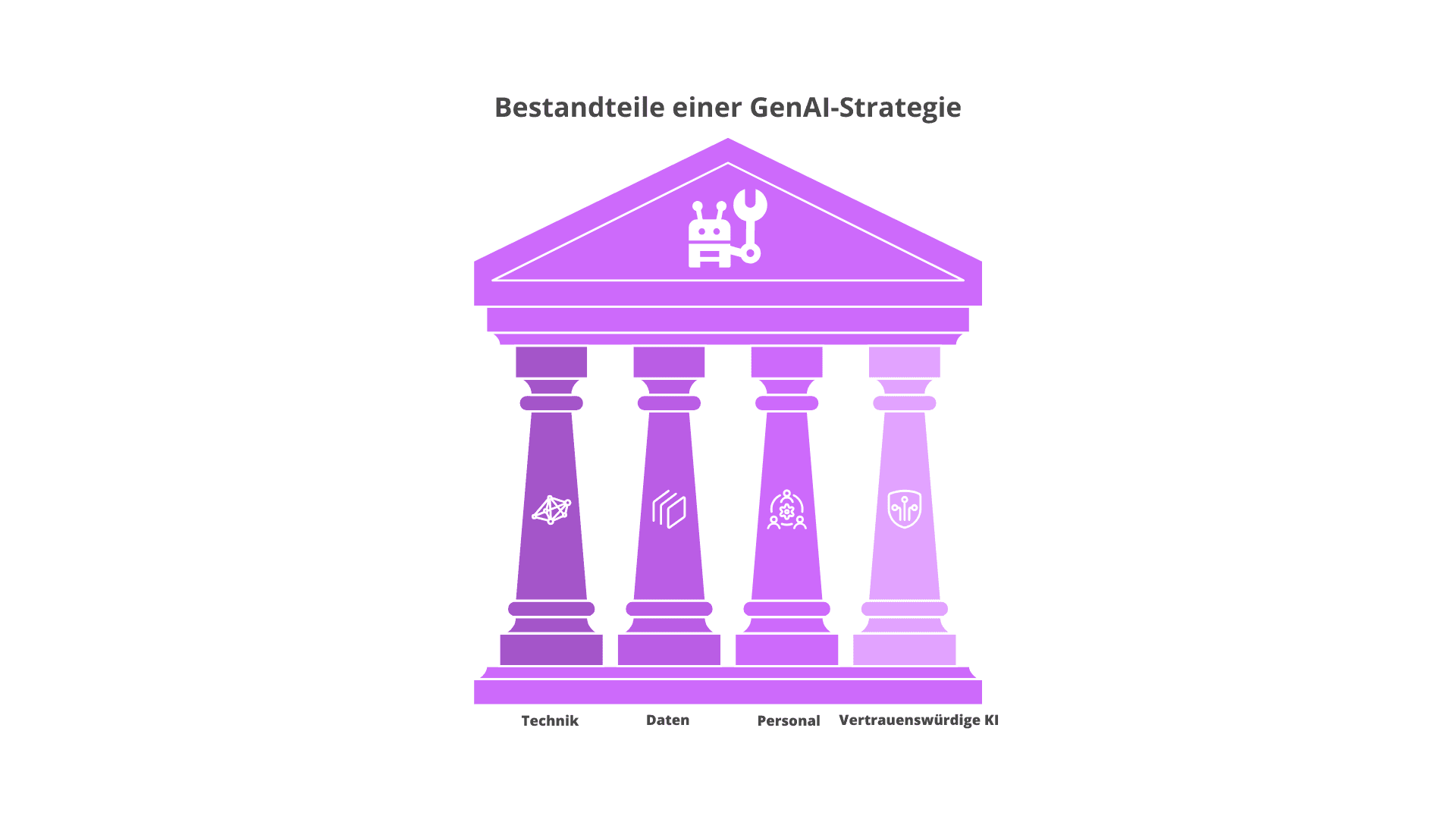
A robust GenAI strategy comprises several components. First: vision and strategy, defined in alignment with the corporate strategy. It sets out how AI can optimise business processes and enable innovative solutions.
Second: choosing suitable technology and targeted service provider management. Infrastructure and software must be scalable and flexible enough to meet future requirements. Cloud services play a central role here.
Third: effective data management that ensures quality, integrity, and data protection. Fourth: a focus on people management – training, capability building, and change management. And fifth: building trustworthy AI through clear policies, risk management, and controls.
Strategy also means leveraging synergies
When developing a strategy, it is advisable to consider potential overlaps with existing corporate, IT, or data strategies. If you already have a functioning operating model and governance structure, you do not need to reinvent everything – but rather selectively extend existing structures.
This reduces complexity, avoids duplication, and increases acceptance. Because AI adoption is not a parallel universe to the existing organisation – but an extension of it.
Conclusion
A GenAI strategy provides the foundation for everything that follows: the right governance, the appropriate technology, and organisational change. Without it, AI adoption remains an experiment. With it, it becomes a programme with measurable value. In the next part of this series, we will look at how governance and risk management for generative AI can be set up in concrete terms.