Research
AI Strategy
Prioritise use cases and ensure profitability

Article by
neuland AI
·
The Use Case Problem
Most companies do not have an ideas problem – they have a prioritisation problem. Workshops produce dozens of possible use cases. The challenge is to identify those that actually create value, are technically feasible and organisationally viable. A structured selection process is therefore not a nice-to-have, but critical to success. Without it, resources are spread across projects that may be technically possible, but are economically irrelevant.
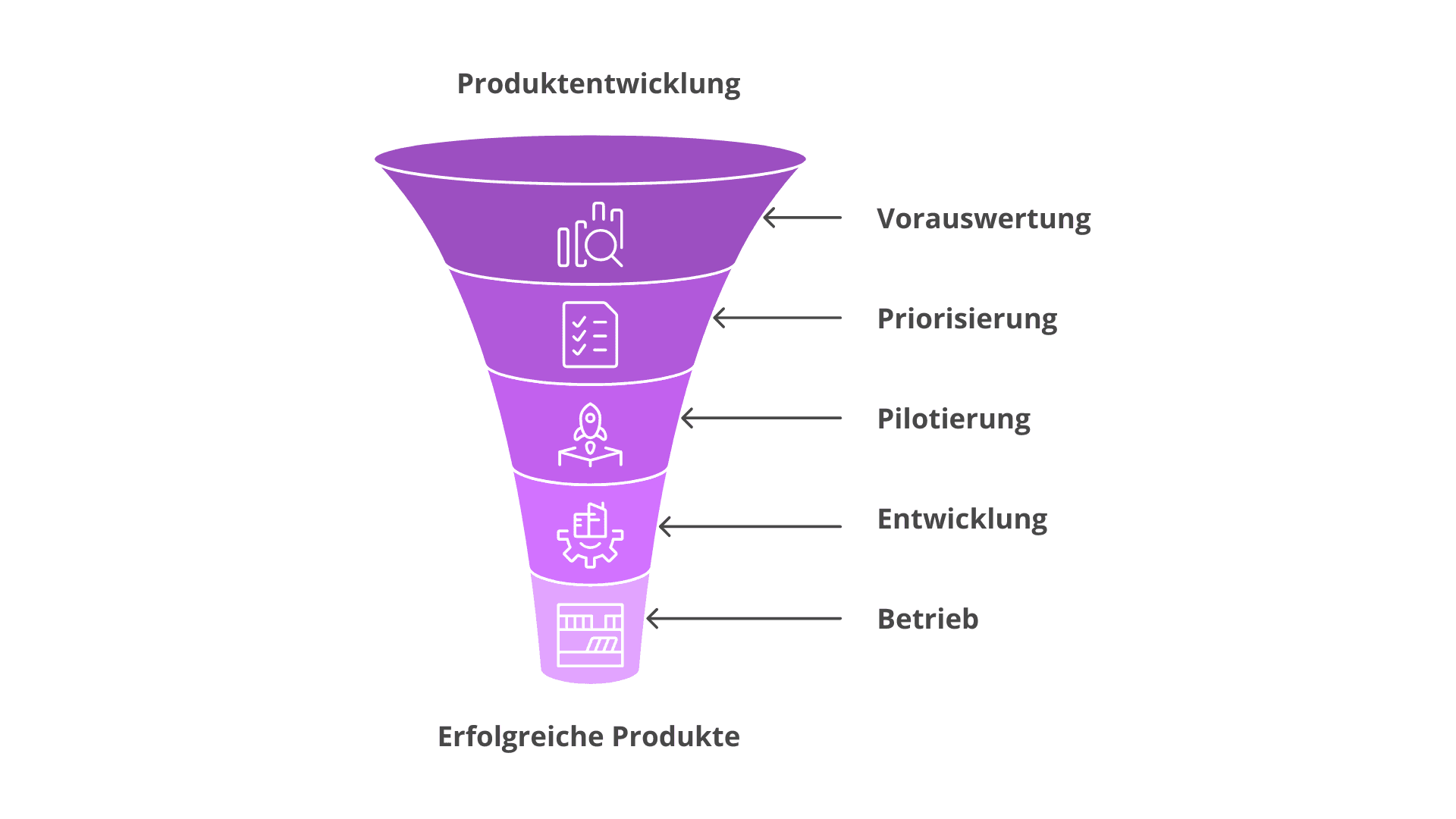
The Funnel Process: Five Phases of Selection
Potential GenAI use cases are identified as part of structured ideation processes. Workshops, the analysis of industry-specific best practices and internal processes help to capture a broad spectrum. An exploratory approach is central here: relevant use cases often emerge in day-to-day operations, not in the innovation lab. In the initial assessment, the identified use cases are analysed in terms of the problem statement, objectives and functional requirements.
User groups are defined, and benefits and effort are systematically evaluated. Ethical and data protection requirements are an integral part of this. Pragmatic business cases are created for prioritised use cases. The resulting portfolio enables efficient allocation of resources and supports accelerated implementation.
Piloting: Learning Before Scaling
The pilot phase evaluates practical suitability under real conditions. A prototype is developed to test design, functionality and feasibility. Early stakeholder feedback helps identify shortcomings and reduces development risks. The structured approach is crucial: defining objectives, project preparation, technical implementation, evaluation and the rollout decision. Following a successful pilot, implementation follows, remaining flexible and iterative so that it can respond to new requirements. Holistic cost consideration: Due to the dynamic development of AI models and technologies, it is advisable to carry out a comprehensive cost assessment at an early stage. This should include licensing, pricing models, operating models and the maturity of the solution. In addition to implementation costs, long-term operating costs and potential replacement costs should also be taken into account. A common mistake is focusing on technology costs while underestimating the effort required for change management, training and organisational adaptation. The economic assessment must reflect the full picture.
Conclusion
Use case prioritisation is not a one-off task, but an iterative process with regular feedback loops. Those who proceed systematically avoid wastage and build a portfolio that is scalable. The next part looks at the operating model and organisational anchoring.