AI Strategy
Research
Gartner Top 10 Strategic AI Trends: Why AI architecture now decides victory or defeat

Article by
neuland AI
·
The new Gartner study “Top 10 Strategic Technology Trends for 2026” confirms what we at neuland.ai have been observing for years:
The era of playful AI experimentation is over.
Gartner describes a world in which AI is no longer “a tool” but critical infrastructure. This is exactly where our core theses come in:
AI is not a tool; it is becoming the new core of the company.
Organisations must reorganise around AI.
AI management and orchestration platforms are the key.
Gartner’s strategic trends – from Domain-specific Language Models (DSLMs) and Multiagent Systems through to Geopatriation and AI Security Platforms – boil down to one central question:
How do I orchestrate dozens of AI applications, hundreds of AI agents and countless workflows securely, sovereignly and at scale?
This is precisely the domain of the neuland.ai HUB.
What Gartner predicts: From sovereign infrastructure to specialised AI systems
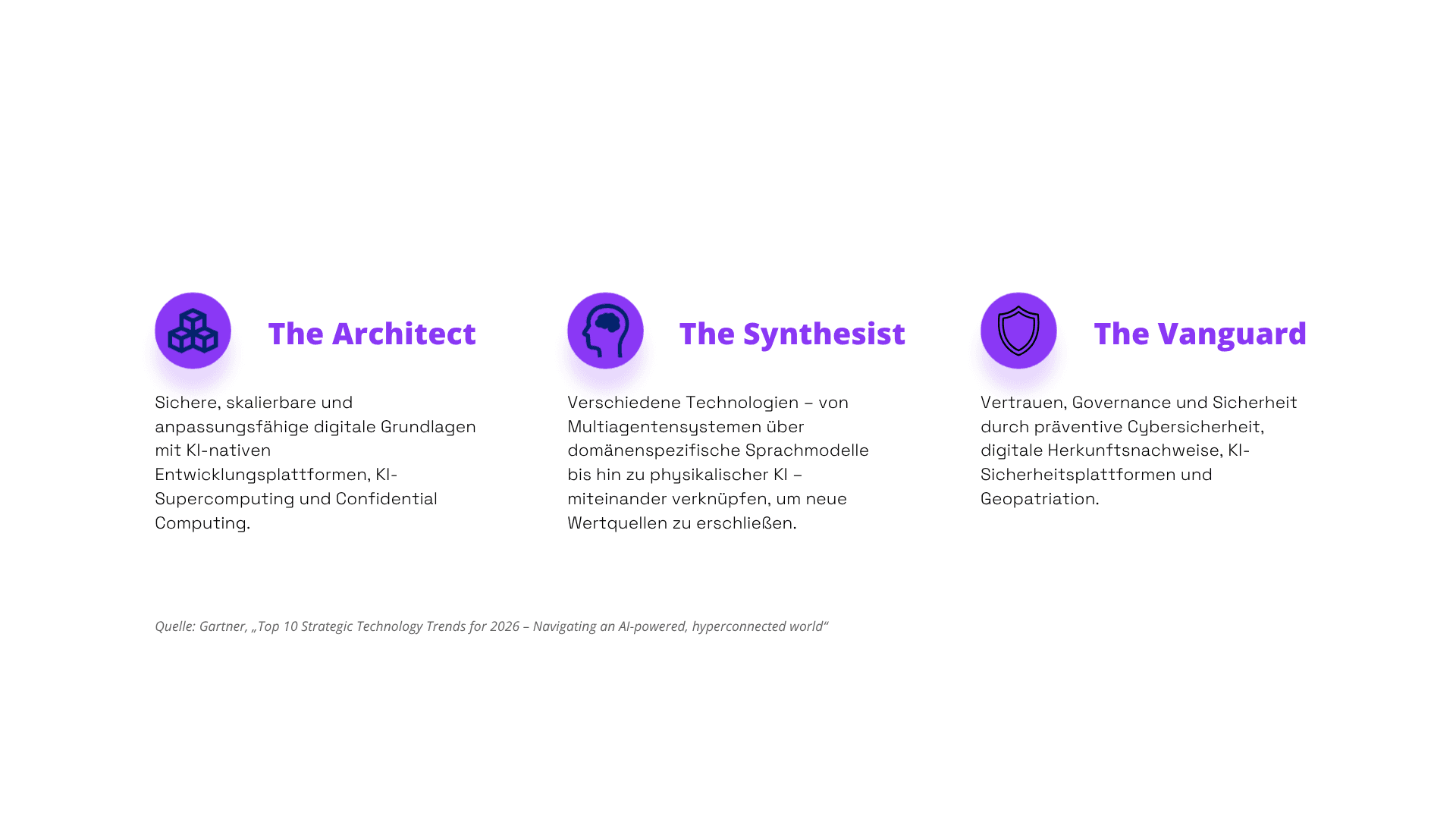
The study groups the trends into three clusters: The Architect, The Synthesist, The Vanguard. For companies that truly want to make AI the core of their business, several points are especially relevant.
Geopatriation & Confidential Computing: Sovereignty instead of dependency
With the Geopatriation trend, Gartner states clearly:
By 2030, 75% of companies will move workloads from global hyperscaler clouds to sovereign or local environments.
This is more than a location issue – it is a question of control over data, models and compute:
Stricter regulation (EU AI Act, GDPR, DORA, BRAO etc.) is forcing companies to operate workloads in specific jurisdictions.
According to Gartner, Confidential Computing is becoming the standard for protecting data “in use” – i.e. during processing, not only in storage and transit.
This brings a topic into focus that we have addressed for a long time:
Data sovereignty and technical sovereignty as a competitive factor.
Anyone who builds their company’s AI core on an opaque, global black-box infrastructure will ultimately lose control – over data, over compliance, and over their own value creation.
Domain-specific Language Models (DSLMs): Depth instead of breadth
Gartner predicts that by 2028, more than 60% of enterprise GenAI models will be domain-specific. The message is clear:
Value is not created in a “one-size-fits-all” LLM.
Value is created in specialised internal models optimised for proprietary data, proprietary processes and proprietary regulations.
This exactly matches our experience:
Generic LLMs are excellent for prototypes – but in productive operation they fail due to:
Industry regulation (banking, legal, public sector, industry)
Liability issues
Traceability and auditing
Costs and performance under high usage intensity
That is why the focus is shifting towards:
DSLMs based on industry-specific, curated data
Models that run on-premises or in sovereign cloud environments
Models that integrate cleanly into governance, compliance and quality processes
Multiagent Systems & AI Security Platforms: Orchestration becomes mandatory
Gartner describes a strong rise in Multiagent Systems (MAS):
Specialised AI agents that jointly handle complex workflows – instead of a single “jack-of-all-trades” agent. In parallel, Gartner sees:
AI Security Platforms (AISPs) as a central layer for controlling AI-specific risks such as prompt injection, rogue agents and data leakage.
Digital Provenance as a core element for tracking the origin, integrity and use of models, data and AI-generated content.
The consequence:
Without a central platform that orchestrates agents, models, data, roles, rights, costs and risks, AI in the enterprise becomes a security and governance risk.
Or, put more pointedly:
Without orchestration, AI transformation is not scalable.
Why this is central for us – and why we have already built for it
What Gartner outlines for 2026 is exactly the reality for which we developed the neuland.ai HUB.
Our basic assumption from the very beginning was:
AI will become the new operational core of the company.
Companies need an AI management and orchestration platform, deeply integrated into IT, data landscape and governance.
Europe needs trustworthy, legally compliant, sovereign AI architectures – “Made in Europe”, “Made in Germany”.
The neuland.ai HUB addresses the trends described by Gartner very concretely:
Sovereign infrastructure & geopatriation in practice
Hosting options: sovereign cloud, private cloud, on-premises – depending on regulatory pressure and risk appetite.
Compliance with GDPR, EU AI Act, DORA, BRAO, ISO 27001/9001 and other standards is an integral component, not an “add-on”.
Confidential Computing, access controls, role & rights management – implemented technically, not just described on slides.
This enables companies to do what Gartner demands:
Move workloads, models and critical data into controlled, legally compliant and at the same time high-performance environments – without an innovation backlog.
DSLMs & domain AI: From buzzword to productive architecture
We are seeing exactly what Gartner predicts – in ongoing client projects:
Banks and financial service providers use the neuland.ai HUB to build internal models for lending processes, risk assessment and compliance checks.
Law firms and legal departments rely on domain-specific models that are BRAO-compliant and process sensitive documents securely.
Industrial companies operate DSLMs for maintenance, logistics and supply-chain optimisation – closely linked to their facilities and processes.
For this, the neuland.ai HUB provides:
A platform for securely integrating different DSLMs (proprietary, open source, third-party)
Tools for governance, monitoring, model lifecycle, cost control
A unified layer for access, integration into existing systems and workflows
This makes the “specialisation of intelligence” that Gartner speaks of a reality – under your control.
Multiagent Systems & orchestration: From a single app to an AI-first organisation
When companies operate dozens of AI applications and hundreds of AI agents, new challenges arise:
Who is allowed to execute what?
How do we log and audit decisions?
How do we prevent shadow AI and BYOAI?
How do we keep costs, security and compliance under control?
The neuland.ai HUB is built precisely for this:
Orchestration of AI agents, assistants and workflows across departments
Central control of data flows, policies, costs and usage
Integration into existing IT landscapes – from DMS and ERP to specialist procedures
This ensures AI does not become a patchwork of isolated solutions, but rather a company-wide operating system – the technical foundation for the “AI-first organisation” we talk about.
Our conviction here fully aligns with what Gartner formulates between the lines:
Only those who orchestrate AI will scale AI.
Only those who operate AI sovereignly will create trust.
Only those who deeply integrate AI will emerge from this transformation as winners.
From the Gartner paper to your own reality: Test the neuland.ai HUB
You do not need another isolated solution.
You need a platform that makes AI the new core of your company..
If you would like to see what this can look like in your environment:
Test our demo version of the neuland.ai HUB – with your use cases, your requirements, your compliance perspective.
Or speak directly with our sales team to plan a guided deep dive – including architecture and governance perspectives tailored specifically to your company.