Research
AI Agents
The “Siri of Public Transport”: Why Mobility Needs More Than a Smart App

Article by
neuland AI
·
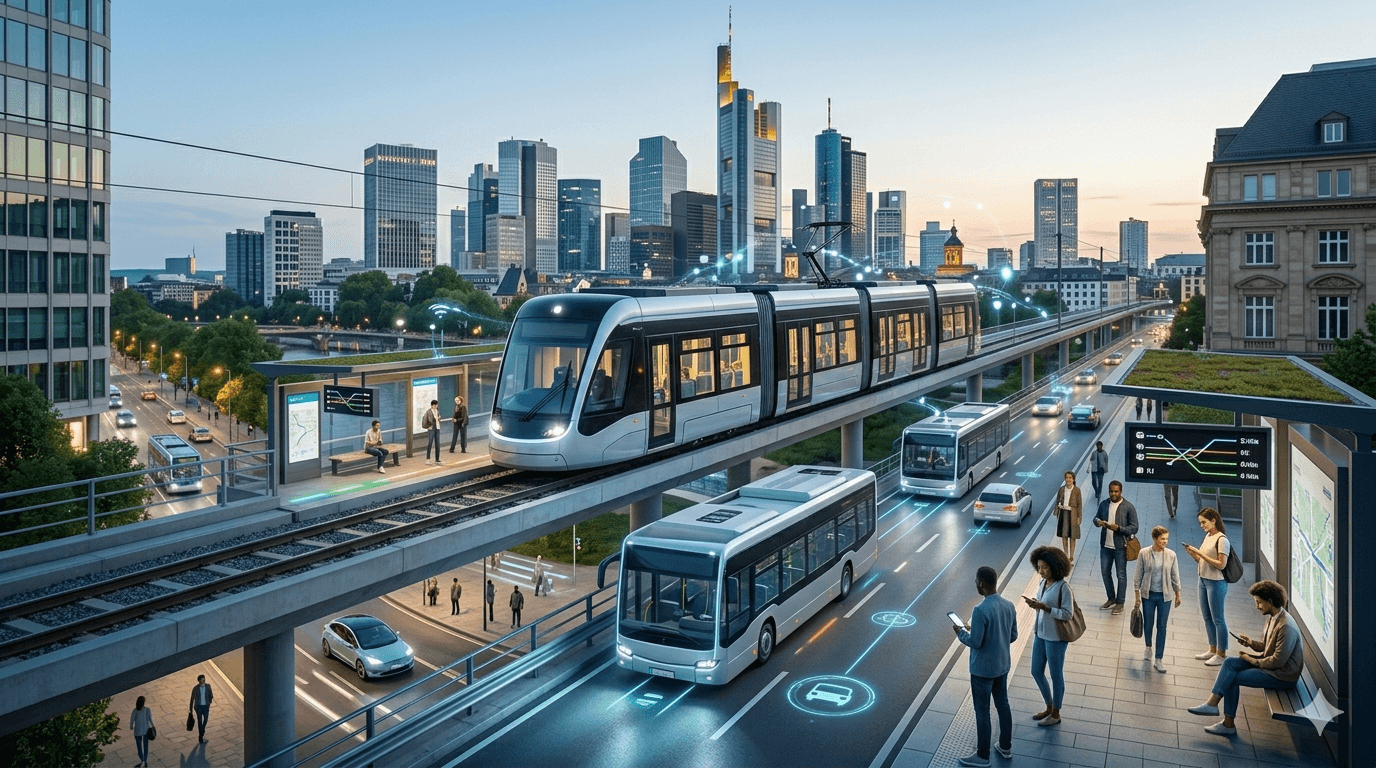
Public transport in Germany often feels like a relic from the pre-digital era. Fragmented responsibilities, regional tariff islands, a patchwork of different apps, static timetable PDFs that remain valid until the next disruption – and then the search starts all over again. At the same time, concepts are emerging that sound like a radical break with this reality: a single intelligent assistant that understands where you are, where you want to go, that knows timetables in real time, books tickets, replans when services fail, and, if needed, adds a taxi or shuttle – all via voice, in many languages. “I want to go from here to Altona” is enough; everything else is orchestrated in the background.
Behind this vision lies far more than a new interface or another chatbot. It is about an AI agent system that connects the entire public transport ecosystem – from passenger information to ticketing to on-demand services – into one coherent experience. A system that does not just respond, but actively guides: “Leave now, your bus arrives in seven minutes, your ticket is already stored.” This is where the real revolution starts. Such a system cannot simply be placed “on top” of the existing public transport landscape. It forces transport operators and networks to rethink their organisations around AI.
At the core of these new public transport concepts is a network of specialised AI agents that each take over different tasks while collaborating on a shared platform. One agent accesses timetables and real-time data, calculates routes, and takes delays and connections into account. Another understands complex tariff rules and regional boundaries, finds the right ticket, implements best-price logic and handles payment and receipts. A third agent focuses on disruptions: it detects failures, informs proactively, suggests alternatives, and ensures the travel chain remains intact. Additional agents handle multilingual interaction and accessibility, understand speech, translate it into clear guidance, and adapt information to each passenger’s situation.
To ensure this intelligent public transport assistant does not only look impressive in a demo but can handle real data and real disruptions every day, you need much more than a single AI model. Deep integration into operational reality is crucial: timetable and control systems, ticketing and billing systems, customer databases, disruption and dispatch processes all need to be connected. On top of that, strict regulatory requirements apply. AI in public transport must comply with GDPR, the EU AI Act, IT security standards, and the governance rules of public authorities. Public transport does not become less complex – but it will be run in a fundamentally different way: data-driven, adaptive, AI-centric.
This is precisely why AI in public transport must not be treated as a nice-to-have tool. AI is not just another piece of software you put next to your existing systems. AI becomes the new core of the organisation. It reaches deeply into value creation, processes, and decision logic: how disruptions are prioritised, which alternatives are offered to passengers, how resources are planned, capacities distributed, timetables adjusted. All of these are areas where AI can play a central role – if it is embedded correctly.
At neuland.ai, we see this embedding as the decisive lever for successful AI projects. Our core conviction is that organisations must reorganise themselves around AI. It is not enough to tweak existing structures or launch yet another app. Anyone who truly wants to transform public transport needs to align processes, roles, responsibilities, data flows and IT architecture with an AI-centric operating logic. This is not a frontend project; it is a rebuild at the heart of the system.
In other industries – financial services, manufacturing, logistics, legal – we repeatedly see the same pattern. Ambitious AI pilots and impressive proof-of-concepts are launched. But without a solid architecture underneath, they remain isolated solutions. The result: POC graveyards, shadow AI, unofficial tools, and increasing risk for data protection and compliance. Transferring this pattern one-to-one to public transport would be disastrous: here we are dealing with critical infrastructure, public trust, and public budgets.
This is why AI management and orchestration platforms are the real key to this transformation. Only they make it possible to control, monitor and safely operate dozens of AI applications, thousands of assistant functions, and, over time, hundreds of agents in a unified way. The neuland.ai HUB has been developed precisely for this purpose: as a secure, scalable AI platform “Made in Germany” that integrates deeply into existing IT landscapes and covers core requirements such as governance, compliance, data sovereignty, and reliability.
Applied to public transport, this means: the voice-controlled mobility assistant is just the visible tip of the iceberg. Below the surface lies the platform on which the different agents are orchestrated – from timetable forecasts and ticketing logic to disruption workflows, customer communication, and internal assistants for control rooms and planning teams. On this level, data flows are defined, role and permission models are implemented, costs become transparent, and regulatory requirements are enforced in code. This is how a strategic AI infrastructure emerges, capable of supporting not just one, but many applications and agents in a robust manner.
Our experience with highly regulated environments shows how crucial this platform approach is. In sectors such as finance or legal, it is strictly defined which data may flow where, which decisions must be explainable, and which controls are mandatory. The neuland.ai HUB maps these requirements into technology and combines them with modern AI capabilities. Corporate knowledge is made AI-ready, ontologies structure content, dynamic language models and agents operate on this basis – always under the clear premise of security, transparency, and data sovereignty.
Public transport faces a very similar challenge – only under even greater public scrutiny. Anyone thinking about a “Siri for public transport” today must, at the same time, think about platform architecture, agent orchestration, governance, compliance, and long-term operating models. Otherwise, the result will be an impressive pilot that never scales into everyday operations. Our customers who started early with neuland.ai on their journey towards becoming AI-first organisations prove that a different path is possible. They are not building collections of isolated AI tools, but strategic AI infrastructures. On this foundation, they can roll out new applications and agents step by step, without having to start from scratch each time.
Ultimately, this is about much more than a convenient journey planner. It is about the broader AI transformation that turns AI into the foundation of the organisation. AI is no longer an add-on; it becomes the operational layer on which processes, data flows, and decisions are orchestrated. Organisations that deliberately shape this transformation have the greatest chance of emerging as winners from this revolution.
If you work in a transport association, an operating company, a mobility platform, or a responsible authority and you are asking how to use AI not as a risk but as a stable backbone of your services, it is worth taking a close look at the neuland.ai HUB. Our platform is designed to turn initial use cases into robust, scalable solutions – from voice-based passenger information to internal AI assistants for planning and operations and on to complex agent systems that support public transport end-to-end.
You can try out the demo version of the neuland.ai HUB and experience how AI applications and agents can be centrally orchestrated and securely operated. Or you can contact our sales team directly if you would like to discuss concrete scenarios in public transport or adjacent mobility domains.
AI is not a tool; it becomes the new core of the enterprise – and thus the new core of mobility. The question is not whether this will happen, but who will actively shape it. neuland.ai – enabling AI Transformation.
Image/visual: AI-generated, neuland.ai