Research
AI Agents
AI Strategy
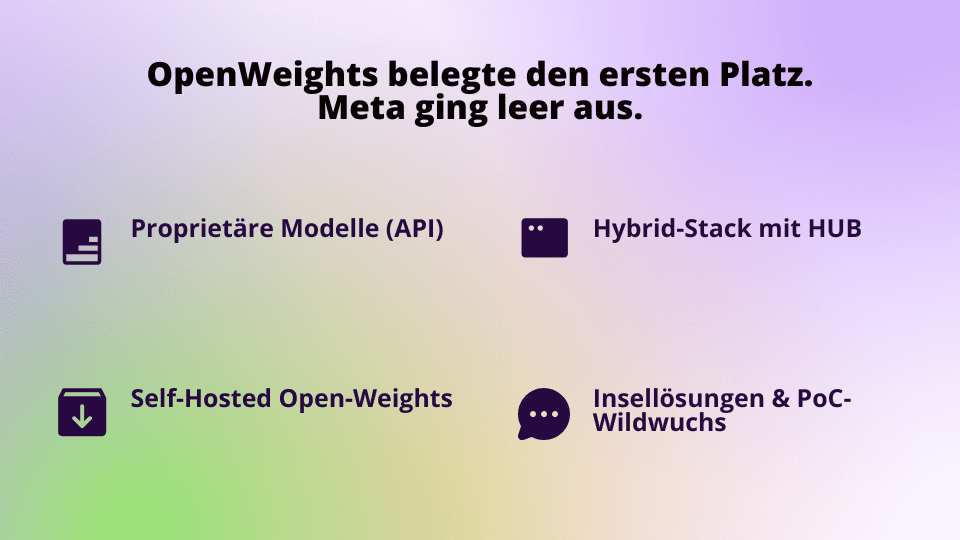
Open weights took the top spot. Meta walked away. The real question is where these models actually run.

Article by
Dr. Anoj Winston Gladius
·
In the same week, an open-source model briefly claimed #1 on the hardest software-engineering benchmark in AI — and Meta retired its open-source strategy at the frontier. The two events look opposite. They point in the same direction. For enterprise buyers in the DACH region, what matters now is not which model wins the next benchmark, but the deployment topology underneath it, the orchestration layer above it, and how compliant a stack you can stand up before 2 August 2026.
The first week of April 2026 produced two announcements that will keep echoing for the rest of the year.
On 7 April, Z.ai (formerly Zhipu AI) released GLM-5.1: a 754-billion-parameter Mixture-of-Experts model with 40B active parameters, a 200K context window, and full MIT-licensed weights on Hugging Face. It scored 58.4 on SWE-Bench Pro, edging past GPT-5.4 (57.7) and Claude Opus 4.6 (57.3). [¹] It was the first open-weight model ever to lead that benchmark. It held the position for nine days before Claude Opus 4.7 reclaimed it at 64.3. [²] Notably, GLM-5.1 was trained on approximately 100,000 Huawei Ascend 910B chips, with zero NVIDIA hardware in the loop — an infrastructure milestone that matters independently of the benchmark itself. [³]
On 8 April — the very next day — Meta released Muse Spark: its first proprietary frontier model in three years, built by Superintelligence Labs under Alexandr Wang following a reported $14.3 billion investment in Scale AI. [⁴] Mark Zuckerberg's company, which built its credibility in this space on Llama and an estimated 1.2 billion downloads, is now guiding $115–135 billion in AI capex for 2026 and explicitly walking away from open-weight releases at the frontier. Meta says it "hopes to open-source future versions." The developer ecosystem that built on top of Llama is now being asked to wait for a timeline the company has declined to commit to. [⁵]
Read together, these two stories tell us something important: frontier-grade capability is no longer where the moat sits. If MIT-licensed open weights can briefly take the top spot on a serious benchmark, and the company that anchored the open-source flywheel for three years can walk away from it in a single quarter, then "which model is best" is a question with an increasingly short half-life.
What does sit still long enough to be a real business decision? Where the model runs, who controls it, and how it gets orchestrated into the actual business.
What we're seeing in client engagements right now
Across our active engagements, more clients than ever are asking us to deploy the neuland.ai HUB on their own infrastructure, paired with self-hosted open-weight models. This is no longer an exotic configuration. For organisations in regulated sectors — financial services, legal, public administration, healthcare, industry — it is becoming the default question rather than the edge case.
Three forces have converged to make it so.
1. The EU AI Act enforcement clock. On 2 August 2026 — just over three months from now — the Commission's enforcement powers over GPAI providers activate, and the high-risk system obligations become enforceable, with administrative fines of up to €15 million or 3% of global turnover for relevant infringements, and €35 million or 7% for prohibited practices. [⁶] Demonstrating data residency, audit-trail completeness, technical documentation, and ongoing risk management to a regulator becomes materially harder when your inference path runs through a US hyperscaler under the CLOUD Act. For organisations subject to DSGVO, DORA or BRAO alongside the AI Act, the compounding effect is not hypothetical — it is the single most common driver of on-prem requests I see this quarter.
2. The reliability lesson from Q1. The silent default changes in Claude Code in February and March — adaptive thinking, the move from effort: high to medium without broad announcement — gave every serious engineering team a concrete demonstration of what vendor-controlled inference actually means in practice. [⁷] The point is not that any single provider is unreliable. The point is that no single provider can be your only path, and "stable foundation" is a deployment choice, not a property of the model. AWS does not silently throttle EC2 performance. Google Cloud does not quietly downgrade database throughput. The model-provider layer has, so far, held itself to a different standard — and enterprise architectures need to account for that.
3. Open weights have measurably caught up for the workloads enterprises actually run. Independent evaluations now put GLM-5.1 at roughly 94.6% of Claude Opus 4.6's overall coding capability. [⁸] On document processing, classification, retrieval-augmented chat, structured extraction, summarisation, and the other workloads that make up the majority of enterprise AI traffic, the capability gap is functionally zero. European sovereign options are maturing in parallel: Mistral Large 3 (675B MoE under Apache 2.0) and Aleph Alpha's PhariaAI stack now offer genuinely credible European-origin alternatives with on-premises deployment and guaranteed EU data residency. [⁹] The crossover point where self-hosting beats API economics typically sits around 2 million tokens per day. Most of our mid-size enterprise clients clear that within a single department within a few months of go-live.
A forcing function nobody planned for
Behind the regulatory and technical drivers, there is a third force reshaping the conversation: the operational model of enterprise software itself is being rewritten in public. When Snap announced 1,000 layoffs in April — roughly a quarter of its planned headcount, with AI now producing more than 65% of new code — the announcement moved the stock 11% in pre-market trading. [¹⁰] Gartner now forecasts that over 40% of agentic AI projects will be cancelled by 2027, while Composio data shows that 97% of executives have deployed agents over the past year, but only 12% of those initiatives reach production at scale. [¹¹]
The read-across for enterprise buyers is not "AI replaces engineers." It is that the economic case for AI at scale is now real enough to bet operational headcount on — and the failure rate at the production stage is still punishingly high. That combination makes the architecture decisions of Q2 2026 more consequential than the model-choice decisions of Q1. A stack that cannot move between model providers as capability and pricing shift, or cannot be audited against EU obligations without heroic effort, or cannot absorb the next "silent default change" without breaking production, is not production-grade infrastructure — regardless of which logo is on the model serving it.
The trap nobody talks about
Here is where most projects walk into a wall: open weights are not an enterprise AI capability. They are an engine.
Self-hosting GLM-5.1 in BF16 means roughly 1.49 TB of model weights, a serving stack (vLLM, SGLang, xLLM or equivalent), an enterprise-grade GPU cluster, and a routing layer before you can call your first prompt. [¹²] None of that gives you:
a way for the business to consume the capability without rebuilding the integration to SAP, SharePoint, M365, your DMS and your CRM for every new use case
governance that survives a model swap — RBAC, audit, retention, output policies bound to capabilities rather than to a specific endpoint
observability that can detect when your self-hosted model is degrading on your workload, not on a public leaderboard
the ability to route the narrow set of workloads where a proprietary model still wins (long-horizon coding agents, certain reasoning-heavy tasks) to that model, while everything else runs on open weights you control
a consistent surface for the business to build KI-Apps, assistants, and workflows without re-implementing compliance for each one
This is the work the orchestration and management layer does. It is also the layer that is missing in roughly 80% of the AI stacks I see when we engage with a new client. Without it, "we deployed an open-source model on-prem" just relocates the chaos. The integration burden, the governance gaps, and the operational fragility move with it — and in regulated environments, they compound.
What the topology looks like in practice
The pattern consolidating in our delivery work for Q2 2026 is straightforward in principle and demanding in execution. The neuland.ai HUB sits as the management and orchestration plane — identity, RBAC, audit trail, capability abstraction, output shaping, and the assistant, workflow and KI-App surfaces the business actually consumes. Underneath, on the model layer, clients typically keep one or two proprietary endpoints (Claude, GPT, or Gemini) for the workloads where the capability gap still justifies the external dependency, and run open-weight models — most often deployed on-prem or in an EU-located private cloud — for everything else. The HUB routes traffic between them under policy, holds the integration to enterprise systems centrally so that individual use cases do not reimplement it, and gives compliance and security teams a single surface to audit.
The result is not "open source versus proprietary." It is a deployment topology where each layer does the job it is good at, no layer is load-bearing for the whole organisation, and model-layer decisions can be revisited quarterly without rewriting the enterprise integration surface.
What to do in Q2 2026
For organisations serious about getting this right before the August deadline bites, the sequence we are running with clients is this: inventory every AI workload currently in production or pilot; classify each one by data sensitivity, latency requirements and capability profile; assign each to an intended model tier (proprietary, open-weight hosted, open-weight on-prem); stand up the orchestration and governance layer before migrating workloads rather than after; and only then begin the model-layer work. In that order, the architecture survives the next model cycle. In any other order, you are rebuilding compliance on top of a stack that was not designed for it.
Personal take
I do not read GLM-5.1 and Muse Spark as a referendum on open versus closed. I read them as evidence that the value in enterprise AI is moving away from the model itself. The model layer is becoming a commodity tier with multiple credible suppliers, increasingly substitutable, and increasingly cheap to run on infrastructure you control. The differentiator is now the layer above — the one that lets a regulated organisation actually operate AI as a managed capability rather than as a collection of integrations to a US-hosted API.
For European companies in particular, the timing is not subtle. With the EU AI Act's enforcement teeth coming out in just over three months, the question every CIO and CISO should be asking right now is not "which model should we standardise on?" but "what does our model topology look like, where does inference happen, and what manages it?"
Open weights matter. On-prem matters. European sovereign options are now credible enough to build on. But none of that is production-grade infrastructure without the orchestration layer that turns it into something a regulated business can run with confidence — and more importantly, can still be running, unchanged, after the next frontier-model announcement lands.
¹ Z.ai, GLM-5.1 release, 7 April 2026. Hugging Face: zai-org/GLM-5. Self-reported SWE-Bench Pro: 58.4. Independent corroboration on Code Arena: Elo 1,530 (rank 3). Note: SWE-Bench Pro results are self-reported pending third-party replication.
² SWE-Bench Pro leaderboard, April 2026. Claude Opus 4.7 reported at 64.3 on 16 April 2026.
³ Training infrastructure disclosure, Z.ai, April 2026: ~100,000 Huawei Ascend 910B chips, zero NVIDIA involvement — notable given Z.ai's placement on the US Entity List in January 2025.
⁴ Meta AI, "Introducing Muse Spark", 8 April 2026. VentureBeat coverage, 8 April 2026. Scale AI investment reported at $14.3 billion.
⁵ Meta 2026 AI capex guidance: $115–135 billion, approximately double 2025. Llama download count of 1.2 billion reported by early 2026. Meta statement: hopes to open-source future Muse versions, no timeline committed.
⁶ Regulation (EU) 2024/1689. GPAI enforcement powers, governance rules and high-risk obligations enter into application on 2 August 2026. Reference: European Commission AI Office, DLA Piper "Latest wave of obligations under the EU AI Act take effect", August 2025.
⁷ See my earlier analysis: "Wenn KI-Systeme plötzlich schlechter werden", neuland.ai, 17 April 2026. Adaptive Thinking documented by Anthropic; default effort reduced from high to medium in Claude Code on 3 March 2026.
⁸ Independent SWE-Bench Verified composite analysis, April 2026. GLM-5.1 trails Claude Opus 4.6 on Terminal-Bench + NL2Repo composite (54.9 vs 57.5) but leads on isolated SWE-Bench Pro.
⁹ Mistral Large 3 (December 2025): 675B MoE, Apache 2.0, Devstral 2 coding variant at 72.2% on SWE-bench Verified. Aleph Alpha PhariaAI: enterprise GenAI operating system with on-premises deployment and guaranteed European data residency; partnership with AMD and Schwarz Digits.
¹⁰ Snap Q1 2026 restructuring: ~1,000 roles reduced, >300 open roles closed, ~$500M annualised savings. CEO Evan Spiegel citing AI-driven productivity; reported AI contribution to new code: >65%.
¹¹ Gartner forecast: >40% of agentic AI projects cancelled by 2027. Composio AI Agent Report: 97% of executives deployed agents past year, 12% reach production at scale. March 2026 survey of 650 enterprise technology leaders: 78% with agent pilots, 14% at production scale.
¹² Z.ai GLM-5.1 deployment documentation, github.com/zai-org/GLM-5. BF16 weights ~1.49 TB; recommended serving stacks: vLLM, SGLang, xLLM, Ktransformers.