AI Strategy
Jensen Huang and the taper-pin lesson for AI sovereignty
Jensen Huang and the taper-pin lesson for AI sovereignty

Dr. Anoj Winston Gladius
·
8
Min. Lesezeit

The taper pin as a key: standardisation opens AI sovereignty.
aufsatz
Image: AI generated with neuland.ai HUB
Jensen Huang told Germany not to export its knowledge. A taper pin from 1918 shows how.
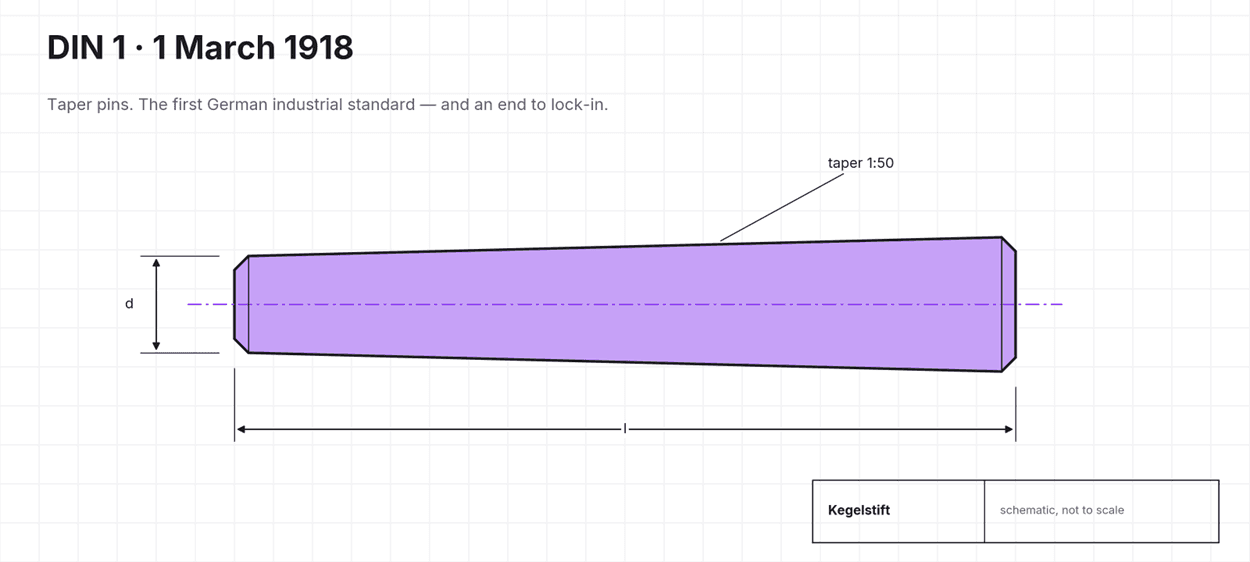
DIN 1, the first German industrial standard, fixed the dimensions of taper pins. Schematic drawing by neuland.ai; history in note 8.
On 19 October 2026, Nvidia's chief executive Jensen Huang stood beside Chancellor Friedrich Merz at the Invest in Germany Summit in Berlin and gave German industry a piece of advice that would have been unthinkable from an American technology executive a few years ago. Germany's manufacturing data and expertise, he said, are a natural resource that belongs to the nation; Germany should import AI technology, but it "should not export your culture, export your values, export your knowledge." Six days earlier, police in Amsterdam had removed a server from a data centre at the request of the United States and begun copying its contents for American authorities - a reminder that a server standing in Europe is not, by itself, a European anything. Read together, these are not two unrelated stories. They pose the question German boards now have to answer: what does it actually take to keep knowledge at home? The surprising thing is that Germany has answered this question before. Once in 1887, when a British law meant to shame German goods turned into the most valuable label in manufacturing. And once on 1 March 1918, when the first German industrial standard was published. It was about a taper pin - and it was, in effect, a rebellion against lock-in.
This is the thirty-first piece in a series I have been writing for neuland.ai. Each one has pushed the same underlying argument forward: the value, the risk and the moat in enterprise AI are not in the model. They are in the layer above and around it.¹ The previous piece looked at the lobbying campaign telling Europe that independence is unaffordable. This one looks at what independence is actually made of - and finds the answer in a drawer of machine parts.
Knowledge is kept at home not by where it is stored, but by whether it is codified into parts you own.
A server in Amsterdam
On 13 October 2026, police in Amsterdam removed a server from a data centre on the city's Science Park, acting on a request from the United States under the mutual legal assistance treaty between the two countries, and began making a digital image of its contents for American authorities.² The server belonged to Autistici/Inventati, an Italian collective that provided email and hosting to activist groups.
I will not comment on the case itself, or on the designation behind it; that is a matter for courts and governments, and the facts are still developing - later Dutch reporting indicated that the data had not yet been handed over.² What matters here is the mechanism, and the order of events. After the United States designated the collective in late August, it lost its bank account and its domain name, and its volunteers shut the service down.³ The physical server in a European data centre came last, and by then it barely mattered.
Many European organisations still treat sovereignty as a hosting decision: choose a European data centre and the job is done. Amsterdam shows that the hardware is one link in a chain. Domains, payments, banking, identity, cloud, software licences and AI models all sit in the same chain, and each link runs on rules that somebody else can change.
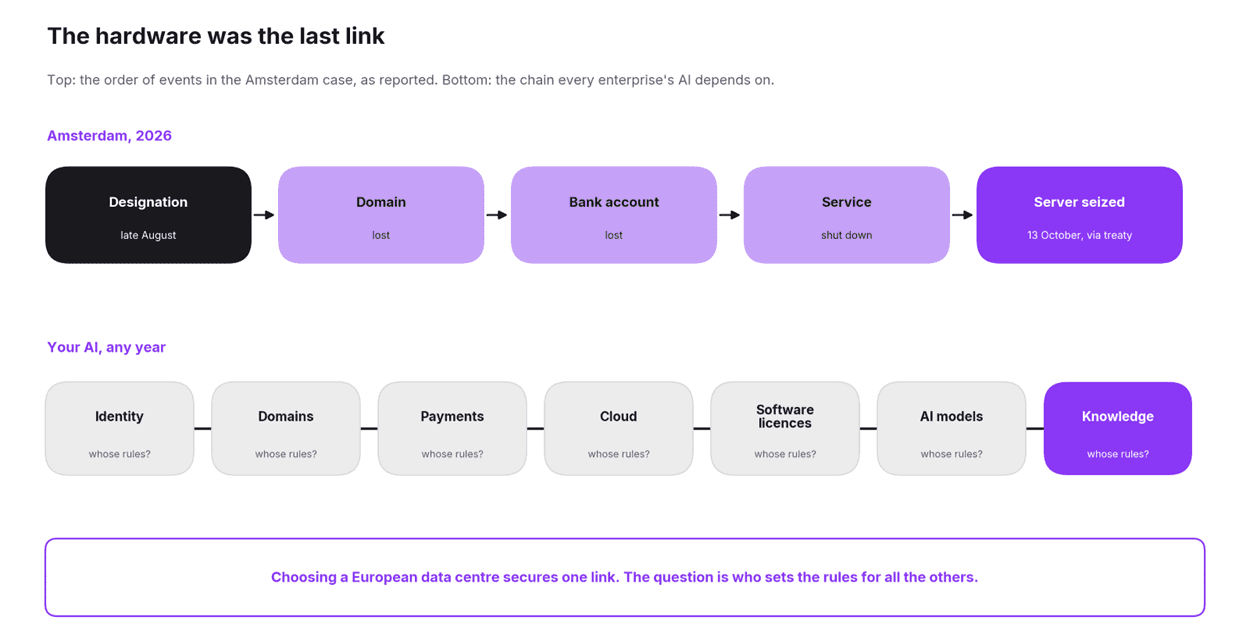
Figure 2. The order of events in the Amsterdam case as reported, and the chain every enterprise's AI depends on. Original diagram by neuland.ai; sources in notes 2 and 3.
What Jensen Huang told Germany
Six days later, Huang made the strongest case yet from inside the American AI industry for Europe keeping control of its own knowledge. Germany's industrial data and decades of manufacturing expertise belong to the nation, he argued; German companies should use AI to codify that expertise, teach it to machines and keep it in the country - to re-engineer the German economy, in the chancellor's phrase. He described the next wave of AI as physical: robots, factories, machines, where digital technology augments heavy industry rather than replacing it.⁴ Before the summit he had been blunter, saying Germany had fallen behind in AI through too much hesitation and analysis, and urging decision-makers to start building.⁴
Nvidia and the German government announced an industrial AI partnership at the summit, building on the Sovereign Open Source Foundation Models alliance, with federal funding directed mainly at computing capacity in Deutsche Telekom's Industrial AI Cloud. Nvidia's GTC conference opens in Berlin the following day, focused on what the company now calls AI factories, physical AI and open models.⁵
There is an obvious irony in an American chief executive telling Germany to keep its knowledge at home. I do not think it is hypocrisy. It is Nvidia's business model stated plainly: Nvidia sells the factory, and - as the previous pieces in this series showed - gives a growing family of open models away, because the model is not where it makes its money.⁶ The value it wants Germany to create sits above its chips, in what German companies teach those machines. The question is who will own that teaching.
1887: the label that was meant to shame
Here is the part that I think German boards will find most useful, and it starts with an insult.
In the 1880s, German manufacturers had a reputation for cheap imitations. Cutlers in Solingen copied the knives of Sheffield, sometimes with inferior steel and sometimes stamped "Sheffield made". On 23 August 1887, the British Parliament responded with the Merchandise Marks Act, which required imported goods to declare their country of origin. The intention was to warn British buyers. The label it created was "Made in Germany".⁷
It backfired spectacularly. Within a few decades, German tools and machines were outperforming their British originals, and by the time of the post-war economic miracle at the latest, "Made in Germany" had become the most valuable mark of quality in manufacturing. A label designed to mark German goods as suspect became proof that they were better.
What changed between the insult and the triumph was not the location of German factories. It was how German industry organised what it knew.
1918: the taper pin that broke a lock-in
On 22 December 1917, in the middle of a war, German industry founded the Normenausschuss der deutschen Industrie - the body we now call DIN. Its purpose, in the language of the time, was to escape production bottlenecks and dependence on individual manufacturers. Ten weeks later, on 1 March 1918, it published its first standard: DIN 1, which fixed the dimensions and materials of taper pins, the small conical pins that hold machine parts together.⁸
Why a taper pin? Because manufacturers had been producing them in their own deviating dimensions - deliberately, in order to bind their customers. A machine built with one supplier's pins needed that supplier's pins forever. DIN 1 made every taper pin interchangeable with every other, and the lock-in disappeared. Four years later, DIN 476 gave the world the A4 sheet of paper, and by the late 1920s German industry had produced thousands of standards.⁸
The first German industrial standard was, in other words, an act of rebellion against lock-in. And it worked for the same reason "Made in Germany" worked: knowledge was codified, made explicit, made interchangeable - and kept inside German industry rather than inside any single supplier.
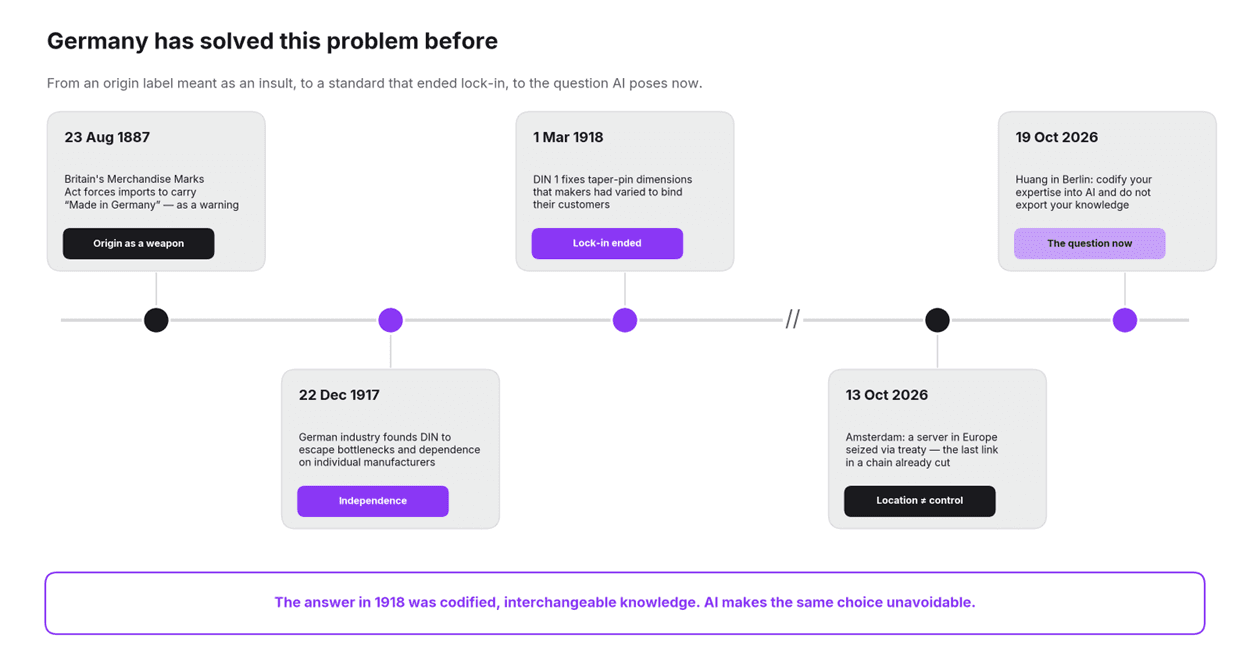
Figure 1. From an origin label meant as an insult, to a standard that ended lock-in, to the question AI poses now. Original timeline by neuland.ai; sources in notes 2, 4, 7 and 8.
2026: whose pin is your knowledge?
Now return to Huang's advice. AI is, above all, a codification technology. It takes what a company knows - its drawings, process specifications, quality records, maintenance histories and the unwritten judgement of its engineers - and turns it into something a machine can use. Huang is right that this is Germany's next opportunity. The question is the one DIN asked in 1917: are you codifying into interchangeable parts, or into somebody else's proprietary pin?
A great deal of European enterprise AI today is the proprietary pin. A company's process knowledge is expressed in one vendor's prompts, agent formats and workflows, fine-tuned on one vendor's platform, and reachable only through one vendor's API. Every call carries a little more of that knowledge out of the building. And leaving is expensive, whether or not anyone intended it to be: the previous piece showed that, by the lobby group's own numbers, about 69 percent of the claimed cost of European cloud sovereignty is the cost of migrating and rewriting software.⁹ That is a taper-pin problem, a century later.
The alternative is the DIN answer, applied to AI. Models whose weights you hold, so that one can be swapped for another the way one standard pin replaces another. Open interfaces between your systems and those models. Your knowledge codified in your own structured model of the business, on infrastructure you control. And a record of what your AI systems did, written by your platform rather than summarised by the model.
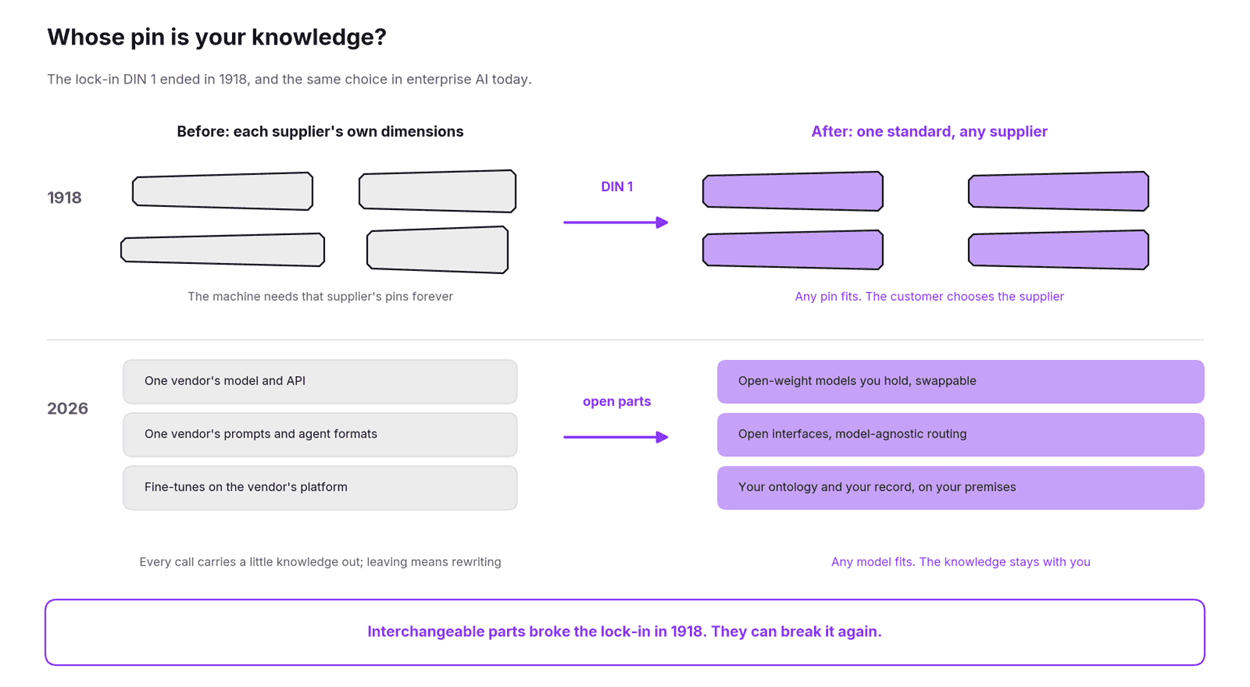
Figure 3. The lock-in DIN 1 ended in 1918, and the same choice in enterprise AI today. Original illustration by neuland.ai.
What "don't export your knowledge" means in practice
For a German manufacturer, Huang's instruction turns into a short list of engineering decisions. Keep the knowledge layer - documents, the ontology of the business, the record of what the AI did - on infrastructure you control, inside a jurisdiction you choose. Run models whose weights you hold for the bulk of the work: Nvidia's own Nemotron family, Mistral and other open-weight models now cover most enterprise tasks. Route to frontier APIs deliberately, task by task, where they genuinely add something and your policy allows it, rather than by default. Map the rest of the chain honestly, link by link. And design the exit before you need it.
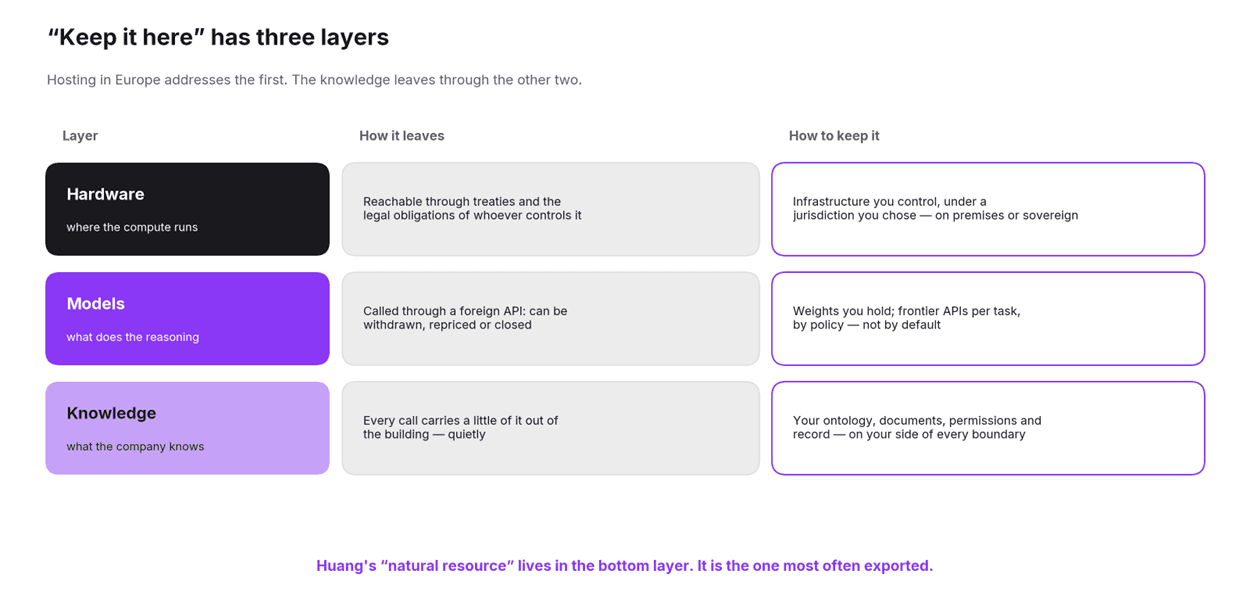
Figure 4. The three layers of keeping knowledge at home. Original diagram by neuland.ai.
None of this is exotic. It is the discipline German industry already applies to its supply chains for parts and materials. It simply has not yet been applied to the supply chain for knowledge. The check below is a quick way to find out where you stand.
The chain-of-control check
Tick each statement that is true for your organisation today. In Word, click the box to tick it.
✓ | Statement | Layer |
☐ | 1. Our core business knowledge — documents, drawings, process specifications — is stored on infrastructure we control, in a jurisdiction we chose. | Knowledge |
☐ | 2. We hold the weights of the models that do most of our AI work. | Models |
☐ | 3. We could replace our main AI model within a month without rewriting our applications. | Models |
☐ | 4. Calls to foreign AI providers are decided task by task, by policy — not by default. | Models |
☐ | 5. Permissions are enforced before any model sees our data. | Knowledge |
☐ | 6. The record of what our AI retrieved and did is written by our platform, not summarised by the model. | Knowledge |
☐ | 7. Our ontology — the structured model of our business — belongs to us and moves with us if we change vendor. | Knowledge |
☐ | 8. We know which links in our chain — identity, domains, payments, cloud, software licences, models — run on rules we do not set. | Chain |
☐ | 9. We have tested what happens if one of those links is cut. | Chain |
☐ | 10. If a key provider cut us off, we could keep our AI systems running elsewhere within weeks. | Chain |
Your score
8–10 ticks | Your pins are your own. You can change suppliers without asking anyone's permission. |
4–7 ticks | Part of your knowledge is shaped to someone else's pin. Start with the knowledge layer — it is the hardest to get back. |
0–3 ticks | You are exporting your knowledge, one call at a time. |
Why the Mittelstand does not need a frontier lab
Huang's most useful point was not about sovereignty at all. It was that the next wave of AI is physical, and that Germany's advantage lies in what it already knows about machines, materials and processes.
That is exactly the work an earlier piece in this series described: AI that reconciles piping and instrumentation diagrams across thousands of documents, or produces engineering geometry that can be measured and audited, using open-source tools the research community has built over decades.¹⁰ Work like that does not need a German frontier model. It needs a platform that connects open models to a company's own engineering knowledge, drives the established tools engineers already trust, keeps everything on the company's premises and records what happened. The Mittelstand has the knowledge and, increasingly, the hardware. What it lacks is the layer in between.
Where neuland.ai stands on this
The neuland.ai HUB is a sovereign AI management and orchestration platform built in Cologne for exactly that layer. It runs on the infrastructure the customer chooses - on premises on the customer's own Nvidia hardware, in a German or European sovereign cloud, or fully air-gapped. Most work runs on open-weight models hosted in house, including Nvidia's Nemotron models, Mistral, GLM, Qwen and DeepSeek, with proprietary models used only where the customer's policy allows. Models are interchangeable parts: routing is decided per task, and changing a model is a configuration decision rather than a rebuild. The company's knowledge layer - its ontology, documents, permissions and the record of every retrieval and decision - belongs to the customer and stays with the customer.¹¹
This is also the answer to a question I hear more and more from German industrial companies: should we wait for the national AI programmes to deliver? Honestly, no. Huang's own advice was to stop analysing and start building, and he is right. The knowledge is already in your building. The open models are already available. The only question is whether the parts that connect them are yours.
Personal take
I want to be careful with the framing here. This piece takes no position on the Amsterdam case or on the designation behind it. It is not anti-American either: Nvidia is an American company, we run its models and its hardware, and its chief executive has made one of the clearest arguments this year for European control of European knowledge.
What I am pushing back against is two habits. The first is reading "keep it here" as "host it here": Amsterdam shows that a server in Europe is only as sovereign as every link in the chain around it. The second is treating sovereignty as a national programme that someone else will deliver. In 1918 it was not delivered by a ministry. It was delivered by engineers who agreed that a taper pin should have the same dimensions no matter who made it. Every company can make that decision about its own AI today.
The regulatory direction points the same way. The Commission's proposed Cloud and AI Development Act is designed so that no foreign authority holds a kill switch over Europe's most sensitive systems, and the EU AI Act has applied broadly since 2 August 2026, with the Digital Omnibus moving the high-risk Annex III obligations to 2 December 2027 and Annex I obligations to 2 August 2028.¹² Both ask enterprises to show who controls their systems. That answer is easiest to give when the parts are yours.
We at neuland.ai would rather help German industry codify its knowledge into parts it owns than into pins someone else can change the size of.
Series articles available at https://neuland.ai/en/resources/insights.
NRC (Marloes de Koning), 13-14 October 2026, as reported by NL Times; CircleID, October 2026; Decrypt, October 2026, including comments from legal experts on the procedure under the 1981 mutual legal assistance treaty between the Netherlands and the United States; later Dutch reporting indicating that, contrary to an earlier police statement, the data had not yet been shared with US authorities.
US Department of the Treasury designation of Autistici/Inventati, late August 2026, as reported by Rights & Dissent (14 October 2026) and Decrypt; on the loss of the collective's bank account and domain name and the shutdown of its services, see CircleID and coverage of the NRC report.
Associated Press (David McHugh), 19 October 2026, on Jensen Huang's remarks at the Invest in Germany Summit in Berlin with Chancellor Friedrich Merz; Euronews (German edition), 19 October 2026, on Huang's earlier remarks in London about Germany's position in AI.
Euronews (German edition), 19 October 2026, on the industrial AI partnership between Nvidia and the German government, its link to the Sovereign Open Source Foundation Models alliance, and federal funding for capacity in Deutsche Telekom's Industrial AI Cloud; Nvidia, GTC Berlin programme, 20-22 October 2026.
See the earlier pieces in this series on the AI capital web and on Nvidia's open Nemotron models.
Merchandise Marks Act 1887 (50 & 51 Vict. c. 28), royal assent 23 August 1887; see https://en.wikipedia.org/wiki/Merchandise_Marks_Act_1887 and https://en.wikipedia.org/wiki/Made_in_Germany; on Solingen imitations of Sheffield goods, see P.M. Wissen, "Warum war ‚made in Germany' ursprünglich ein Makel?"; on the contemporary British alarm, see Ernest Edwin Williams, Made in Germany (London, 1896).
DIN Deutsches Institut für Normung, history of DIN, https://www.din.de/en/din-and-our-partners/din-e-v/history; heise online, "Immer schön konform: 100 Jahre DIN-Norm" (2017), on the founding of the Normenausschuss der deutschen Industrie on 22 December 1917 to escape wartime bottlenecks and dependence on individual manufacturers; heise online, "Zahlen, bitte! 34.000 DIN-Normen für einheitliche Standards" (2018), on DIN 1 of 1 March 1918 and taper pins previously produced in deviating dimensions to bind customers; DIN 476 on paper formats (1922).
See the previous piece in this series on the lobby-funded study of the cost of the Cloud and AI Development Act.
See the earlier piece in this series on nine loops and on industrial engineering work with open-source tools.
neuland.ai HUB: cloud-agnostic deployment on premises, in a German or European sovereign cloud, or air-gapped; per-task model routing under customer-set policy across self-hosted open-weight and proprietary models; customer-owned ontology, permissions and append-only audit. neuland.ai AG retains responsibility for content quality and clean delivery of results across all customer engagements.
European Commission, proposal for the Cloud and AI Development Act, COM(2026) 502, 3 June 2026. Regulation (EU) 2024/1689 (AI Act), broadly applicable from 2 August 2026. Council of the EU and European Parliament provisional political agreement on the Digital Omnibus on AI, 7 May 2026: Annex III high-risk obligations postponed to 2 December 2027; Annex I obligations postponed to 2 August 2028.
Jensen Huang told Germany not to export its knowledge. A taper pin from 1918 shows how.
DIN 1, the first German industrial standard, fixed the dimensions of taper pins. Schematic drawing by neuland.ai; history in note 8.
On 19 October 2026, Nvidia's chief executive Jensen Huang stood beside Chancellor Friedrich Merz at the Invest in Germany Summit in Berlin and gave German industry a piece of advice that would have been unthinkable from an American technology executive a few years ago. Germany's manufacturing data and expertise, he said, are a natural resource that belongs to the nation; Germany should import AI technology, but it "should not export your culture, export your values, export your knowledge." Six days earlier, police in Amsterdam had removed a server from a data centre at the request of the United States and begun copying its contents for American authorities - a reminder that a server standing in Europe is not, by itself, a European anything. Read together, these are not two unrelated stories. They pose the question German boards now have to answer: what does it actually take to keep knowledge at home? The surprising thing is that Germany has answered this question before. Once in 1887, when a British law meant to shame German goods turned into the most valuable label in manufacturing. And once on 1 March 1918, when the first German industrial standard was published. It was about a taper pin - and it was, in effect, a rebellion against lock-in.
This is the thirty-first piece in a series I have been writing for neuland.ai. Each one has pushed the same underlying argument forward: the value, the risk and the moat in enterprise AI are not in the model. They are in the layer above and around it.¹ The previous piece looked at the lobbying campaign telling Europe that independence is unaffordable. This one looks at what independence is actually made of - and finds the answer in a drawer of machine parts.
Knowledge is kept at home not by where it is stored, but by whether it is codified into parts you own.
A server in Amsterdam
On 13 October 2026, police in Amsterdam removed a server from a data centre on the city's Science Park, acting on a request from the United States under the mutual legal assistance treaty between the two countries, and began making a digital image of its contents for American authorities.² The server belonged to Autistici/Inventati, an Italian collective that provided email and hosting to activist groups.
I will not comment on the case itself, or on the designation behind it; that is a matter for courts and governments, and the facts are still developing - later Dutch reporting indicated that the data had not yet been handed over.² What matters here is the mechanism, and the order of events. After the United States designated the collective in late August, it lost its bank account and its domain name, and its volunteers shut the service down.³ The physical server in a European data centre came last, and by then it barely mattered.
Many European organisations still treat sovereignty as a hosting decision: choose a European data centre and the job is done. Amsterdam shows that the hardware is one link in a chain. Domains, payments, banking, identity, cloud, software licences and AI models all sit in the same chain, and each link runs on rules that somebody else can change.
Figure 2. The order of events in the Amsterdam case as reported, and the chain every enterprise's AI depends on. Original diagram by neuland.ai; sources in notes 2 and 3.
What Jensen Huang told Germany
Six days later, Huang made the strongest case yet from inside the American AI industry for Europe keeping control of its own knowledge. Germany's industrial data and decades of manufacturing expertise belong to the nation, he argued; German companies should use AI to codify that expertise, teach it to machines and keep it in the country - to re-engineer the German economy, in the chancellor's phrase. He described the next wave of AI as physical: robots, factories, machines, where digital technology augments heavy industry rather than replacing it.⁴ Before the summit he had been blunter, saying Germany had fallen behind in AI through too much hesitation and analysis, and urging decision-makers to start building.⁴
Nvidia and the German government announced an industrial AI partnership at the summit, building on the Sovereign Open Source Foundation Models alliance, with federal funding directed mainly at computing capacity in Deutsche Telekom's Industrial AI Cloud. Nvidia's GTC conference opens in Berlin the following day, focused on what the company now calls AI factories, physical AI and open models.⁵
There is an obvious irony in an American chief executive telling Germany to keep its knowledge at home. I do not think it is hypocrisy. It is Nvidia's business model stated plainly: Nvidia sells the factory, and - as the previous pieces in this series showed - gives a growing family of open models away, because the model is not where it makes its money.⁶ The value it wants Germany to create sits above its chips, in what German companies teach those machines. The question is who will own that teaching.
1887: the label that was meant to shame
Here is the part that I think German boards will find most useful, and it starts with an insult.
In the 1880s, German manufacturers had a reputation for cheap imitations. Cutlers in Solingen copied the knives of Sheffield, sometimes with inferior steel and sometimes stamped "Sheffield made". On 23 August 1887, the British Parliament responded with the Merchandise Marks Act, which required imported goods to declare their country of origin. The intention was to warn British buyers. The label it created was "Made in Germany".⁷
It backfired spectacularly. Within a few decades, German tools and machines were outperforming their British originals, and by the time of the post-war economic miracle at the latest, "Made in Germany" had become the most valuable mark of quality in manufacturing. A label designed to mark German goods as suspect became proof that they were better.
What changed between the insult and the triumph was not the location of German factories. It was how German industry organised what it knew.
1918: the taper pin that broke a lock-in
On 22 December 1917, in the middle of a war, German industry founded the Normenausschuss der deutschen Industrie - the body we now call DIN. Its purpose, in the language of the time, was to escape production bottlenecks and dependence on individual manufacturers. Ten weeks later, on 1 March 1918, it published its first standard: DIN 1, which fixed the dimensions and materials of taper pins, the small conical pins that hold machine parts together.⁸
Why a taper pin? Because manufacturers had been producing them in their own deviating dimensions - deliberately, in order to bind their customers. A machine built with one supplier's pins needed that supplier's pins forever. DIN 1 made every taper pin interchangeable with every other, and the lock-in disappeared. Four years later, DIN 476 gave the world the A4 sheet of paper, and by the late 1920s German industry had produced thousands of standards.⁸
The first German industrial standard was, in other words, an act of rebellion against lock-in. And it worked for the same reason "Made in Germany" worked: knowledge was codified, made explicit, made interchangeable - and kept inside German industry rather than inside any single supplier.
Figure 1. From an origin label meant as an insult, to a standard that ended lock-in, to the question AI poses now. Original timeline by neuland.ai; sources in notes 2, 4, 7 and 8.
2026: whose pin is your knowledge?
Now return to Huang's advice. AI is, above all, a codification technology. It takes what a company knows - its drawings, process specifications, quality records, maintenance histories and the unwritten judgement of its engineers - and turns it into something a machine can use. Huang is right that this is Germany's next opportunity. The question is the one DIN asked in 1917: are you codifying into interchangeable parts, or into somebody else's proprietary pin?
A great deal of European enterprise AI today is the proprietary pin. A company's process knowledge is expressed in one vendor's prompts, agent formats and workflows, fine-tuned on one vendor's platform, and reachable only through one vendor's API. Every call carries a little more of that knowledge out of the building. And leaving is expensive, whether or not anyone intended it to be: the previous piece showed that, by the lobby group's own numbers, about 69 percent of the claimed cost of European cloud sovereignty is the cost of migrating and rewriting software.⁹ That is a taper-pin problem, a century later.
The alternative is the DIN answer, applied to AI. Models whose weights you hold, so that one can be swapped for another the way one standard pin replaces another. Open interfaces between your systems and those models. Your knowledge codified in your own structured model of the business, on infrastructure you control. And a record of what your AI systems did, written by your platform rather than summarised by the model.
Figure 3. The lock-in DIN 1 ended in 1918, and the same choice in enterprise AI today. Original illustration by neuland.ai.
What "don't export your knowledge" means in practice
For a German manufacturer, Huang's instruction turns into a short list of engineering decisions. Keep the knowledge layer - documents, the ontology of the business, the record of what the AI did - on infrastructure you control, inside a jurisdiction you choose. Run models whose weights you hold for the bulk of the work: Nvidia's own Nemotron family, Mistral and other open-weight models now cover most enterprise tasks. Route to frontier APIs deliberately, task by task, where they genuinely add something and your policy allows it, rather than by default. Map the rest of the chain honestly, link by link. And design the exit before you need it.
Figure 4. The three layers of keeping knowledge at home. Original diagram by neuland.ai.
None of this is exotic. It is the discipline German industry already applies to its supply chains for parts and materials. It simply has not yet been applied to the supply chain for knowledge. The check below is a quick way to find out where you stand.
The chain-of-control check
Tick each statement that is true for your organisation today. In Word, click the box to tick it.
✓ | Statement | Layer |
☐ | 1. Our core business knowledge — documents, drawings, process specifications — is stored on infrastructure we control, in a jurisdiction we chose. | Knowledge |
☐ | 2. We hold the weights of the models that do most of our AI work. | Models |
☐ | 3. We could replace our main AI model within a month without rewriting our applications. | Models |
☐ | 4. Calls to foreign AI providers are decided task by task, by policy — not by default. | Models |
☐ | 5. Permissions are enforced before any model sees our data. | Knowledge |
☐ | 6. The record of what our AI retrieved and did is written by our platform, not summarised by the model. | Knowledge |
☐ | 7. Our ontology — the structured model of our business — belongs to us and moves with us if we change vendor. | Knowledge |
☐ | 8. We know which links in our chain — identity, domains, payments, cloud, software licences, models — run on rules we do not set. | Chain |
☐ | 9. We have tested what happens if one of those links is cut. | Chain |
☐ | 10. If a key provider cut us off, we could keep our AI systems running elsewhere within weeks. | Chain |
Your score
8–10 ticks | Your pins are your own. You can change suppliers without asking anyone's permission. |
4–7 ticks | Part of your knowledge is shaped to someone else's pin. Start with the knowledge layer — it is the hardest to get back. |
0–3 ticks | You are exporting your knowledge, one call at a time. |
Why the Mittelstand does not need a frontier lab
Huang's most useful point was not about sovereignty at all. It was that the next wave of AI is physical, and that Germany's advantage lies in what it already knows about machines, materials and processes.
That is exactly the work an earlier piece in this series described: AI that reconciles piping and instrumentation diagrams across thousands of documents, or produces engineering geometry that can be measured and audited, using open-source tools the research community has built over decades.¹⁰ Work like that does not need a German frontier model. It needs a platform that connects open models to a company's own engineering knowledge, drives the established tools engineers already trust, keeps everything on the company's premises and records what happened. The Mittelstand has the knowledge and, increasingly, the hardware. What it lacks is the layer in between.
Where neuland.ai stands on this
The neuland.ai HUB is a sovereign AI management and orchestration platform built in Cologne for exactly that layer. It runs on the infrastructure the customer chooses - on premises on the customer's own Nvidia hardware, in a German or European sovereign cloud, or fully air-gapped. Most work runs on open-weight models hosted in house, including Nvidia's Nemotron models, Mistral, GLM, Qwen and DeepSeek, with proprietary models used only where the customer's policy allows. Models are interchangeable parts: routing is decided per task, and changing a model is a configuration decision rather than a rebuild. The company's knowledge layer - its ontology, documents, permissions and the record of every retrieval and decision - belongs to the customer and stays with the customer.¹¹
This is also the answer to a question I hear more and more from German industrial companies: should we wait for the national AI programmes to deliver? Honestly, no. Huang's own advice was to stop analysing and start building, and he is right. The knowledge is already in your building. The open models are already available. The only question is whether the parts that connect them are yours.
Personal take
I want to be careful with the framing here. This piece takes no position on the Amsterdam case or on the designation behind it. It is not anti-American either: Nvidia is an American company, we run its models and its hardware, and its chief executive has made one of the clearest arguments this year for European control of European knowledge.
What I am pushing back against is two habits. The first is reading "keep it here" as "host it here": Amsterdam shows that a server in Europe is only as sovereign as every link in the chain around it. The second is treating sovereignty as a national programme that someone else will deliver. In 1918 it was not delivered by a ministry. It was delivered by engineers who agreed that a taper pin should have the same dimensions no matter who made it. Every company can make that decision about its own AI today.
The regulatory direction points the same way. The Commission's proposed Cloud and AI Development Act is designed so that no foreign authority holds a kill switch over Europe's most sensitive systems, and the EU AI Act has applied broadly since 2 August 2026, with the Digital Omnibus moving the high-risk Annex III obligations to 2 December 2027 and Annex I obligations to 2 August 2028.¹² Both ask enterprises to show who controls their systems. That answer is easiest to give when the parts are yours.
We at neuland.ai would rather help German industry codify its knowledge into parts it owns than into pins someone else can change the size of.
Series articles available at https://neuland.ai/en/resources/insights.
NRC (Marloes de Koning), 13-14 October 2026, as reported by NL Times; CircleID, October 2026; Decrypt, October 2026, including comments from legal experts on the procedure under the 1981 mutual legal assistance treaty between the Netherlands and the United States; later Dutch reporting indicating that, contrary to an earlier police statement, the data had not yet been shared with US authorities.
US Department of the Treasury designation of Autistici/Inventati, late August 2026, as reported by Rights & Dissent (14 October 2026) and Decrypt; on the loss of the collective's bank account and domain name and the shutdown of its services, see CircleID and coverage of the NRC report.
Associated Press (David McHugh), 19 October 2026, on Jensen Huang's remarks at the Invest in Germany Summit in Berlin with Chancellor Friedrich Merz; Euronews (German edition), 19 October 2026, on Huang's earlier remarks in London about Germany's position in AI.
Euronews (German edition), 19 October 2026, on the industrial AI partnership between Nvidia and the German government, its link to the Sovereign Open Source Foundation Models alliance, and federal funding for capacity in Deutsche Telekom's Industrial AI Cloud; Nvidia, GTC Berlin programme, 20-22 October 2026.
See the earlier pieces in this series on the AI capital web and on Nvidia's open Nemotron models.
Merchandise Marks Act 1887 (50 & 51 Vict. c. 28), royal assent 23 August 1887; see https://en.wikipedia.org/wiki/Merchandise_Marks_Act_1887 and https://en.wikipedia.org/wiki/Made_in_Germany; on Solingen imitations of Sheffield goods, see P.M. Wissen, "Warum war ‚made in Germany' ursprünglich ein Makel?"; on the contemporary British alarm, see Ernest Edwin Williams, Made in Germany (London, 1896).
DIN Deutsches Institut für Normung, history of DIN, https://www.din.de/en/din-and-our-partners/din-e-v/history; heise online, "Immer schön konform: 100 Jahre DIN-Norm" (2017), on the founding of the Normenausschuss der deutschen Industrie on 22 December 1917 to escape wartime bottlenecks and dependence on individual manufacturers; heise online, "Zahlen, bitte! 34.000 DIN-Normen für einheitliche Standards" (2018), on DIN 1 of 1 March 1918 and taper pins previously produced in deviating dimensions to bind customers; DIN 476 on paper formats (1922).
See the previous piece in this series on the lobby-funded study of the cost of the Cloud and AI Development Act.
See the earlier piece in this series on nine loops and on industrial engineering work with open-source tools.
neuland.ai HUB: cloud-agnostic deployment on premises, in a German or European sovereign cloud, or air-gapped; per-task model routing under customer-set policy across self-hosted open-weight and proprietary models; customer-owned ontology, permissions and append-only audit. neuland.ai AG retains responsibility for content quality and clean delivery of results across all customer engagements.
European Commission, proposal for the Cloud and AI Development Act, COM(2026) 502, 3 June 2026. Regulation (EU) 2024/1689 (AI Act), broadly applicable from 2 August 2026. Council of the EU and European Parliament provisional political agreement on the Digital Omnibus on AI, 7 May 2026: Annex III high-risk obligations postponed to 2 December 2027; Annex I obligations postponed to 2 August 2028.