Architektur
You don't build workflows. You define outcomes.
You don't build workflows. You define outcomes.

Dr. Anoj Winston Gladius
·
16
Min. Lesezeit
aufsatz
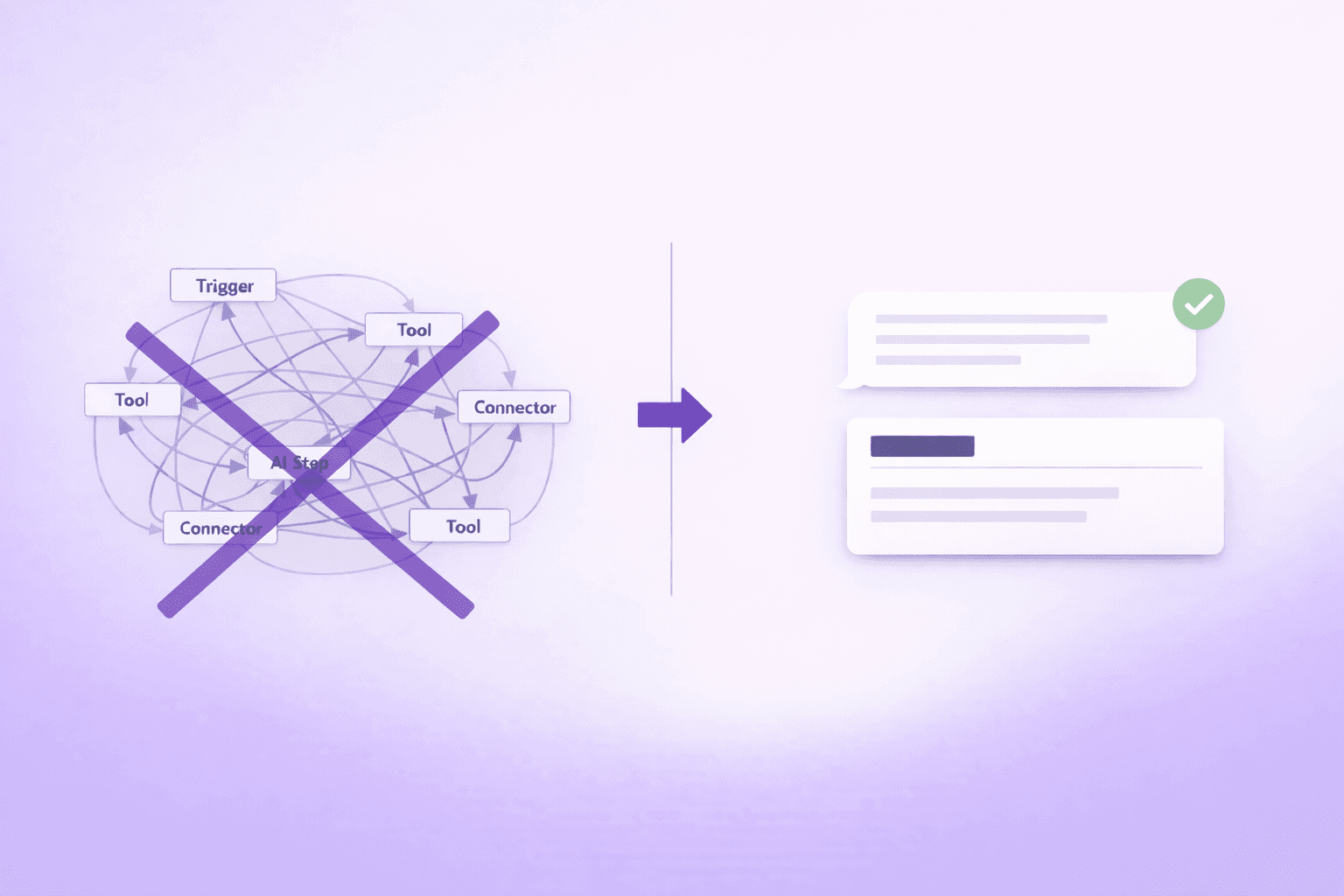
Bild: KI generiert mit neuland.ai HUB
Why the Visual Workflow Builder Paradigm Is the Wrong Abstraction for Enterprise AI.
The dominant marketing narrative in the enterprise AI market of 2026 has settled on a single visual metaphor. Open a canvas. Drag in a trigger. Drag in a tool. Drag in a connector. Place an AI step in the center. Connect everything with arrows. Test. Deploy. Microsoft Copilot Studio, Salesforce Agentforce, n8n, Zapier — every major vendor in the agentic AI category has converged on the same interface, the same vocabulary, the same promise. The promise is identical everywhere: "Non-technical users can now build their own AI agents." Gartner projects that by 2028, agentic AI will be implemented in four out of five companies worldwide via low-code platforms. The promise has won the budget category. It is also the wrong abstraction for what most domain experts in regulated European enterprises actually need from their AI platform — and this structural mismatch is the most important thing serious CIO and CTO buyers should be thinking about right now. Because it determines whether AI ends up in the hands of those who own the business problems, or whether it remains stuck in the hands of the IT power users who already had a Zapier account anyway.
This is the eleventh post in a series I am writing for neuland.ai. The argument running through all posts is the same: in the enterprise AI context, value, risk, and moat reside in the layer above and around the model — not in the model itself.¹ Earlier posts have developed this argument from different angles: control plane and execution surfaces, model drift and multi-LLM observability, model topology, compliance as a system property, agent security, MCP protocol governance, the fast-follower workhorse thesis, the new enterprise data silos, flexibility as architecture, and most recently the ontology race that SAP, Microsoft, Google, and Palantir have jointly entered. The present post closes a thread that the first post implicitly opened in February: if the LLM is a planner within a system rather than the system itself, then who interacts with the system, and through which interface, is the architectural question that will define the coming year of enterprise AI procurement.
The visual workflow builder is one possible answer to that question. For the work that actually needs to be done, it is not the right one.
What Visual Workflow Builders Actually Are — Assessed Fairly
Before the critique, the credit. Visual workflow builders are good tools and they have earned a real place in the enterprise stack. n8n is excellent at what it actually is. So are the other established vendors in this category. They have hundreds of pre-built connectors, mature error handling, functioning observability, established billing models, and large communities of practitioners who know how to make them work.
The question is what they are.
The clearest single statement about what these tools structurally are comes from n8n's own positioning — paraphrased in substance from public materials: AI is one step inside a predefined automation. The workflow defines the logic. AI is powerful, but it operates inside the pre-structured automation rather than acting as the decision-making layer.² That is an honest description and it is accurate. It is also the structural characteristic that makes the entire visual workflow builder category the wrong abstraction for serious AI agent work.
Every visual builder in this category exposes the same four primitives that the builder user must configure: a trigger (what starts the run), instructions (the system prompt — the "least invested component" according to the practitioner literature), tools (the API and connector list the agent can call), and a deployment target.³ The visual builder delivers a working demo in an afternoon. It simultaneously produces the brittleness that the literature on production deployment has consistently documented throughout 2026.
An independent analysis by Nexus on the production trajectory of low-code agent builders in enterprise customers arrived at a number that has since been widely cited in procurement literature: the visual builder gets the customer 40 percent of the way there; the remaining 60 percent — real integrations, compliance posture, edge cases, production hardening, observability that actually surfaces errors — requires engineering.⁴ A European telecom case study published in the same analysis showed 4 hours to the first productive agent, but 6 months and longer to multi-market rollout with a leading visual builder. Gartner's projection for 2026, published earlier this year, reads: 60 percent of enterprise AI projects started in 2026 will be abandoned because the data is not AI-ready.⁵ The visual builder does not fix that. It hides the problem behind a drag-and-drop interface until the production environment exposes it.
The deeper problem is the vocabulary mismatch. A domain expert in a regulated industry — a legal counsel, a financial controller, a process engineer, a claims adjuster, a compliance officer, a supply chain analyst — does not think in triggers and branches and JSON schemas. They think in outcomes. "Find me all customer contracts in the DACH region containing a force majeure clause where the supplier is located in a region affected by a specific event, and flag those where the supplier's force majeure declaration does not cover the contractual subject matter in dispute." That is what a legal counsel asks. There is no version of that question that the domain expert can productively translate into a Copilot Studio canvas, an n8n workflow graph, or an Agentforce topic configuration without taking on the work of an integration architect. Precisely the work for which they hired their IT department.
The visual workflow builder forces the domain expert to learn the vocabulary of architecture in order to express their intent. This translation work is the point at which 60 percent of "non-technical agent building" projects collapse on the path from PoC to production — and it is the structural reason why the Gartner abandonment rate is as high as it is.
What the Platform Technology Now Enables Instead
The deeper point — the one that determines whether the next generation of enterprise AI platforms looks like the current category or like something structurally different — is this: the underlying technology has outgrown the abstraction for which visual workflow builders were designed.
The visual workflow builder paradigm is an abstraction from the 2010s era. It made sense when AI was a narrow, expensive, sometimes wrong tool that could legitimately only be one step in a hand-drawn flow. The flow was the intelligence. The AI was a node.
That assumption no longer holds, and 2026 is the year in which the research literature has converged on the architectural alternative. Recursive Language Models (RLMs) have become, in the words of a leading research group in this field, "the paradigm of 2026."⁶ The structure: instead of loading potentially large input data directly into the model's context window — and accepting the well-documented "context rot" degradation that comes with it — the LLM uses a persistent Python REPL-like environment to inspect, transform, and recursively invoke sub-LLMs as latent operations within its own reasoning loop. Robust independent benchmarks show double-digit percentage improvements over direct LLM calls, context compaction, retrieval-tool-use agents, and code generation agents at the 10-million-token context scales at which the truly interesting enterprise workloads operate.⁷ The most recent academic work on RecursiveMAS, ROMA, and THREAD (NAACL 2025) has formalized the architecture as unified recursive computation over heterogeneous agents — natively multi-hop reasoning, latent thought generation, cross-agent state transfer.⁸
The structural property of RLMs that is decisive for the workflow builder question is straightforward: the LLM can decompose a multi-hop intent into the sub-steps the workflow would have taken — automatically, recursively, with full context discipline, grounded against any knowledge base the platform provides. The domain expert does not draw the flow. The platform assembles the flow.
The complementary half of the architecture is the part where the workflow builder vendors are right: some workflows genuinely must be deterministic, predictable, auditable, and repeatable. Regulated invoice processing, financial close, compliance routing, audit trail generation, regulatory filing. For these, the deterministic orchestration model is the right one — but composed from the domain expert's natural intent and the customer's ontology, not hand-drawn step by step on a canvas. The choice between deterministic orchestration and agentic thread reasoning is itself a routing decision the orchestrator makes per task — not a tooling decision the domain expert must make in advance.
The third pillar of the architecture — and the part that connects this post directly to the previous one — is the ontology. RLMs without a knowledge substrate to reason against are merely clever Python loops over noisy data. The ontology layer is what turns a recursive reasoning loop into a domain-grounded agent that knows what a customer contract is, what a force majeure clause is, what the supplier hierarchy within this specific enterprise looks like, and what rules the regulated workflow actually has.⁹
Taken together: deterministic orchestration plus agentic threads with RLMs plus an automatically generated ontology that grounds the reasoning against the customer's own data. That is the architectural alternative to the visual workflow builder. And it is the architecture on which the neuland.ai HUB is built as a platform; the concrete design is documented in the neuland.ai section further below in this post.
What the Concrete Example Looks Like
The contrast becomes clearer through the legal counsel example I opened with. "Find me all customer contracts in the DACH region containing a force majeure clause where the supplier is located in a region affected by the current disruption, and flag those where the supplier's force majeure declaration does not cover the contractual subject matter in dispute."
The visual workflow builder version of this request requires the domain expert — or more realistically, an integration engineer translating for the domain expert after a discovery call — to do the following: configure a connector to the contract repository, write a search expression to filter by region, decide whether to use vector search, keyword search, or both, configure a connector to the supplier system, write the supplier-to-region join logic, configure the document parser for force majeure clause detection, write the comparison logic between contract scope and declaration scope, configure error handling for incomplete clauses, configure the output format, build a test harness, deploy. The legal counsel waits four months and reviews a result. If the question changes — even slightly — the workflow must be substantially rebuilt.
The architectural alternative is: the domain expert types the sentence, the platform routes it to the ontologically grounded orchestrator, the orchestrator decomposes it into the multi-hop chain the workflow would have taken, RLM-driven agentic threads handle the search, the cross-source join, and the comparative reasoning, deterministic orchestration handles the audit trail and citation back to the source documents, and the answer is in front of the domain expert within the same conversation. The next question is asked the same way. The workflow was never built — because the workflow did not need to be built. The system assembled the path.
That is the difference between "you can build agents" and "agents are a property of the platform." The former is a sales pitch about tooling. The latter is an architectural commitment about who does which work.
Where neuland.ai Stands
The neuland.ai HUB is built around exactly this paradigm. The following architecture diagram shows the design at a glance.
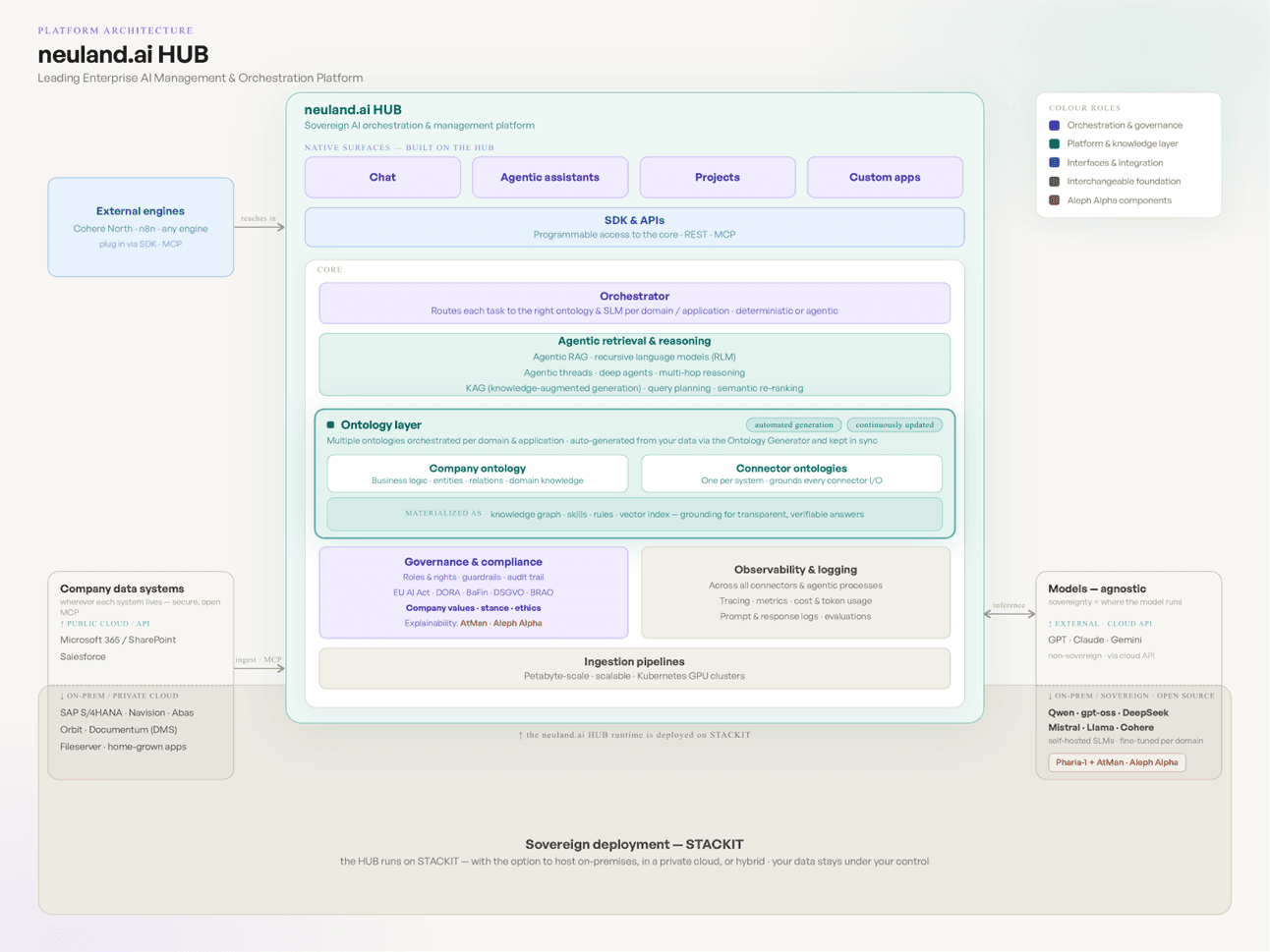
Figure: Platform architecture of the neuland.ai HUB — Enterprise AI Management & Orchestration Platform. Sovereign deployment on STACKIT with on-premises, private cloud, and hybrid options.
The orchestrator routes each task to the appropriate ontology and the appropriate SLM per domain or application — deterministically or agentically. Agentic Retrieval and Reasoning encompasses agentic threads, deep agents, multi-hop reasoning, RLMs, KAG (Knowledge-Augmented Generation), query planning, and semantic re-ranking. The native surfaces — Chat, Agentic Agents, Projects, Custom Apps — are designed to express intent, not to architect workflows.¹⁰
Beneath that lies an automatically generated ontology layer covering both enterprise-level business logic and per-connector grounding; governance and compliance are applied uniformly across deterministic and agentic execution; observability and logging span the entire surface; petabyte-scale ingestion pipelines form the foundation. Sovereign deployment on STACKIT, with on-premises, private cloud, and hybrid options. Model layer agnostic — frontier proprietary where the workload permits; self-hosted SLMs for sovereign workloads, fine-tuned per domain.
The part I want to state clearly to the readership of this series — and which I have kept measured across the previous ten posts in the interest of not overpromising — is this: the research team behind these capabilities is delivering. The MVP of the Recursive Language Model thread architecture, the deep agents, the multi-hop reasoning fabric, the agentic retrieval primitives — these are not architecture slides. This is working software, currently in rigorous internal testing in our research environment, and being progressively integrated into the HUB according to a staged release plan. The research work is consistently aligned with what the academic literature now describes as state of the art — RLMs, recursive multi-agent systems, multi-hop reasoning fabrics, deep agent architectures — and is being brought into a form that withstands production deployment within regulated DACH enterprises. Product management has the final call on what moves from the research environment into the HUB and reaches our customers — measured against the same operating standard by which the entire platform is measured: rigorous evaluation against real customer workloads, full GDPR compliance, sovereign deployment topology, audit trail discipline, and clean integration with everything the HUB already delivers.
We are driving this from both directions simultaneously. The research side brings new capability into the MVP and stress-tests it. The product side integrates what survives the tests into the HUB, at the release cadence that customer engagements require. It is not glamorous work, and the most important parts of it — rigorous evaluation, calibration against real customer workloads, integration discipline — are precisely the work that generates no headlines but determines whether an enterprise AI platform withstands the procurement and operational scrutiny that European enterprise buyers will bring to bear over the next twelve months.
My Personal Assessment
The visual workflow builder will remain a real part of the enterprise stack, and the major vendors who have built around it will continue to deliver genuinely useful tools for the workloads these tools are actually suited for. None of this is a prediction that Copilot Studio, Agentforce, or n8n will disappear. They will not disappear. They will continue to be the right answer for workflows that genuinely benefit from being hand-drawn by someone who can hand-draw them.
What the market has not yet fully internalized, in my view, is this: the visual workflow builder is simultaneously a structural ceiling on who can actually use enterprise AI. The drag-and-drop interface is sold as the democratization of AI agent building. In practice, it is a more accessible version of the integration developer role — and that role, however well-tooled, is not the same role as the domain expert who owns the business problem. On the day European enterprises understand that the architectural alternative is for the platform to take over the assembly from natural intent, the entire question of who can use enterprise AI changes. It changes faster than budget cycles and faster than the major vendors who have spent the past 18 months building their marketing around the visual builder paradigm can reposition.
The argument I have been making in this series since the first post in February is: the value in enterprise AI lies in the layer above the model. That is the same argument, applied once more to the question of how the layer above the model is used. The visual workflow builder is one answer. We are working — openly and according to a deliberate plan — on another. And the architecture is now on the table, visible in this post, for anyone who wants to compare.
A Brief Note on the Regulatory Backdrop
As it continues to evolve: the political agreement on the EU Digital Omnibus of 7 May 2026 has shifted the high-risk obligations under Annex III from 2 August 2026 to 2 December 2027, and Annex I to 2 August 2028.¹¹ GPAI enforcement powers under Chapter V remain on the original date of 2 August 2026. The strategic implication is unchanged from previous posts in this series: the architectural decisions made in Q3 2026 are the ones that will determine whether your AI stack survives the procurement cycles of 2027 intact.
You don't build workflows. You formulate outcomes. That is the architecture we are working toward, and that is the work ahead.
Notes and Sources
[1] Series posts at neuland.ai/insights. Previous posts cover: control planes and execution surfaces; model drift, multi-LLM strategy, and observability; model topology and hyperscaler independence; compliance as a system property; agent security and the lethal trifecta; MCP protocol governance; the fast-follower workhorse thesis; the new enterprise data silos created by SAP/Microsoft/ServiceNow/Salesforce AI gateways; flexibility as architecture following the Fable-5 recall, Microsoft Build 2026, and the European workhorse ecosystem; and the ontology consolidation following SAP/Microsoft/Google/Palantir announcements.
[2] n8n product positioning, paraphrased in substance from public materials and independently summarized in the no-code platform analysis literature: "AI as one step inside a predefined automation. The workflow defines the logic. AI is powerful, but it operates inside a predefined automation rather than acting as the decision-making layer." See independent overviews and comparative analyses of the low-code agent builder category, January 2026.
[3] The four-primitive structure of low-code agent builders — trigger, instructions (system prompt), tools, deployment — is the shared interface across all leading vendors in the category. The formulation of "instructions as the least invested component" is widely attested in the practitioner literature; see e.g. AIUnpacker, "Build Agentic AI Systems Without Coding in 2026," January 2026.
[4] Nexus, "Top 10 Low-Code AI Agent Builders for Enterprise (2026)," February 2026. The 40/60 production deployment gap has been repeatedly described across multiple independent enterprise low-code analyses throughout Q1 and Q2 2026.
[5] Gartner AI Agent Projections, 2026: 60 percent of enterprise AI projects started in 2026 will be abandoned due to data not being AI-ready. By 2028, agentic AI will be implemented in approximately four out of five companies globally via low-code platforms — with significant differences in the production path depending on the platform.
[6] Recursive Language Models (RLMs): see Prime Intellect, "Recursive Language Models: the paradigm of 2026," 2026, describing the RLM scaffolding pattern in which an LLM uses a persistent Python REPL to inspect input data, transform context, and recursively invoke sub-LLMs as latent operations within its own reasoning loop. The general phenomenon of "context rot" with long inputs is documented in Hong, Troynikov, and Huber, "Context rot: how context degradation affects LLM performance," Chroma Technical Report, July 2025.
[7] Empirical performance: RLMs benchmarked against direct LLM calls, context compaction, retrieval-tool-use agents, and code generation agents across deep research, information aggregation, code repository understanding, and synthetic pairwise reasoning. A frontier closed model (GPT-5) and a frontier open model (Qwen3-Coder-480B) both show that RLM scaffolding outperforms alternatives by double-digit percentage points — at 10-million-token context sizes with substantially less degradation at long contexts. See "Recursive Language Models," published evaluations throughout 2026.
[8] RecursiveMAS (arXiv 2604.25917, April 2026); ROMA: Recursive Open Meta-Agent Framework (arXiv 2602.01848, 2026); THREAD: Thinking deeper with recursive spawning (Schroeder et al., NAACL 2025, ACL Anthology, doi 10.18653/v1/2025.naacl-long.427). The convergent direction of this literature is the formalization of recursive multi-agent systems as unified latent-space computation over heterogeneous agents, with cross-agent state transfer and native multi-hop reasoning.
[9] For the underlying ontology argument and its connection to the recursive reasoning loop, see the previous post in this series on the ontology race following the announcements from SAP Sapphire / Microsoft Build / Google Cloud Next / Palantir Foundry.
[10] neuland.ai HUB platform architecture, as shown in the diagram above. Core elements: orchestrator routing per ontology and SLM per domain/application (deterministic or agentic); Agentic Retrieval and Reasoning (Agentic RAG, Recursive Language Models, Agentic Threads, Deep Agents, Multi-Hop Reasoning, KAG, Query Planning, Semantic Re-Ranking); ontology layer (Company Ontology and Connector Ontologies, automatically generated, continuously updated, materialized as knowledge graph, skills, rules, vector index); governance and compliance (roles and rights, guardrails, audit trail, EU AI Act / DORA / BaFin / GDPR / BRAO, explainability via AtMan and Aleph Alpha); observability and logging across all connectors and agentic processes; petabyte-scale ingestion pipelines on Kubernetes GPU clusters; sovereign deployment on STACKIT with on-premises, private cloud, and hybrid options; model-agnostic (frontier proprietary via cloud API where the workload permits; self-hosted SLMs — Qwen, gpt-oss, DeepSeek, Mistral, Llama, Cohere, Pharia-1 with AtMan by Aleph Alpha — for sovereign workloads). neuland.ai AG assumes content and outcome responsibility for clean delivery across all customer engagements.
[11] Political agreement between the Council of the EU and the European Parliament on the Digital Omnibus on AI, 7 May 2026. Annex III high-risk obligations shifted from 2 August 2026 to 2 December 2027 (16-month delay); Annex I obligations shifted to 2 August 2028 (12-month delay); Article 50(2) watermarking shifted to 2 December 2026. GPAI enforcement powers under Chapter V remain on the original date of 2 August 2026.
Why the Visual Workflow Builder Paradigm Is the Wrong Abstraction for Enterprise AI.
The dominant marketing narrative in the enterprise AI market of 2026 has settled on a single visual metaphor. Open a canvas. Drag in a trigger. Drag in a tool. Drag in a connector. Place an AI step in the center. Connect everything with arrows. Test. Deploy. Microsoft Copilot Studio, Salesforce Agentforce, n8n, Zapier — every major vendor in the agentic AI category has converged on the same interface, the same vocabulary, the same promise. The promise is identical everywhere: "Non-technical users can now build their own AI agents." Gartner projects that by 2028, agentic AI will be implemented in four out of five companies worldwide via low-code platforms. The promise has won the budget category. It is also the wrong abstraction for what most domain experts in regulated European enterprises actually need from their AI platform — and this structural mismatch is the most important thing serious CIO and CTO buyers should be thinking about right now. Because it determines whether AI ends up in the hands of those who own the business problems, or whether it remains stuck in the hands of the IT power users who already had a Zapier account anyway.
This is the eleventh post in a series I am writing for neuland.ai. The argument running through all posts is the same: in the enterprise AI context, value, risk, and moat reside in the layer above and around the model — not in the model itself.¹ Earlier posts have developed this argument from different angles: control plane and execution surfaces, model drift and multi-LLM observability, model topology, compliance as a system property, agent security, MCP protocol governance, the fast-follower workhorse thesis, the new enterprise data silos, flexibility as architecture, and most recently the ontology race that SAP, Microsoft, Google, and Palantir have jointly entered. The present post closes a thread that the first post implicitly opened in February: if the LLM is a planner within a system rather than the system itself, then who interacts with the system, and through which interface, is the architectural question that will define the coming year of enterprise AI procurement.
The visual workflow builder is one possible answer to that question. For the work that actually needs to be done, it is not the right one.
What Visual Workflow Builders Actually Are — Assessed Fairly
Before the critique, the credit. Visual workflow builders are good tools and they have earned a real place in the enterprise stack. n8n is excellent at what it actually is. So are the other established vendors in this category. They have hundreds of pre-built connectors, mature error handling, functioning observability, established billing models, and large communities of practitioners who know how to make them work.
The question is what they are.
The clearest single statement about what these tools structurally are comes from n8n's own positioning — paraphrased in substance from public materials: AI is one step inside a predefined automation. The workflow defines the logic. AI is powerful, but it operates inside the pre-structured automation rather than acting as the decision-making layer.² That is an honest description and it is accurate. It is also the structural characteristic that makes the entire visual workflow builder category the wrong abstraction for serious AI agent work.
Every visual builder in this category exposes the same four primitives that the builder user must configure: a trigger (what starts the run), instructions (the system prompt — the "least invested component" according to the practitioner literature), tools (the API and connector list the agent can call), and a deployment target.³ The visual builder delivers a working demo in an afternoon. It simultaneously produces the brittleness that the literature on production deployment has consistently documented throughout 2026.
An independent analysis by Nexus on the production trajectory of low-code agent builders in enterprise customers arrived at a number that has since been widely cited in procurement literature: the visual builder gets the customer 40 percent of the way there; the remaining 60 percent — real integrations, compliance posture, edge cases, production hardening, observability that actually surfaces errors — requires engineering.⁴ A European telecom case study published in the same analysis showed 4 hours to the first productive agent, but 6 months and longer to multi-market rollout with a leading visual builder. Gartner's projection for 2026, published earlier this year, reads: 60 percent of enterprise AI projects started in 2026 will be abandoned because the data is not AI-ready.⁵ The visual builder does not fix that. It hides the problem behind a drag-and-drop interface until the production environment exposes it.
The deeper problem is the vocabulary mismatch. A domain expert in a regulated industry — a legal counsel, a financial controller, a process engineer, a claims adjuster, a compliance officer, a supply chain analyst — does not think in triggers and branches and JSON schemas. They think in outcomes. "Find me all customer contracts in the DACH region containing a force majeure clause where the supplier is located in a region affected by a specific event, and flag those where the supplier's force majeure declaration does not cover the contractual subject matter in dispute." That is what a legal counsel asks. There is no version of that question that the domain expert can productively translate into a Copilot Studio canvas, an n8n workflow graph, or an Agentforce topic configuration without taking on the work of an integration architect. Precisely the work for which they hired their IT department.
The visual workflow builder forces the domain expert to learn the vocabulary of architecture in order to express their intent. This translation work is the point at which 60 percent of "non-technical agent building" projects collapse on the path from PoC to production — and it is the structural reason why the Gartner abandonment rate is as high as it is.
What the Platform Technology Now Enables Instead
The deeper point — the one that determines whether the next generation of enterprise AI platforms looks like the current category or like something structurally different — is this: the underlying technology has outgrown the abstraction for which visual workflow builders were designed.
The visual workflow builder paradigm is an abstraction from the 2010s era. It made sense when AI was a narrow, expensive, sometimes wrong tool that could legitimately only be one step in a hand-drawn flow. The flow was the intelligence. The AI was a node.
That assumption no longer holds, and 2026 is the year in which the research literature has converged on the architectural alternative. Recursive Language Models (RLMs) have become, in the words of a leading research group in this field, "the paradigm of 2026."⁶ The structure: instead of loading potentially large input data directly into the model's context window — and accepting the well-documented "context rot" degradation that comes with it — the LLM uses a persistent Python REPL-like environment to inspect, transform, and recursively invoke sub-LLMs as latent operations within its own reasoning loop. Robust independent benchmarks show double-digit percentage improvements over direct LLM calls, context compaction, retrieval-tool-use agents, and code generation agents at the 10-million-token context scales at which the truly interesting enterprise workloads operate.⁷ The most recent academic work on RecursiveMAS, ROMA, and THREAD (NAACL 2025) has formalized the architecture as unified recursive computation over heterogeneous agents — natively multi-hop reasoning, latent thought generation, cross-agent state transfer.⁸
The structural property of RLMs that is decisive for the workflow builder question is straightforward: the LLM can decompose a multi-hop intent into the sub-steps the workflow would have taken — automatically, recursively, with full context discipline, grounded against any knowledge base the platform provides. The domain expert does not draw the flow. The platform assembles the flow.
The complementary half of the architecture is the part where the workflow builder vendors are right: some workflows genuinely must be deterministic, predictable, auditable, and repeatable. Regulated invoice processing, financial close, compliance routing, audit trail generation, regulatory filing. For these, the deterministic orchestration model is the right one — but composed from the domain expert's natural intent and the customer's ontology, not hand-drawn step by step on a canvas. The choice between deterministic orchestration and agentic thread reasoning is itself a routing decision the orchestrator makes per task — not a tooling decision the domain expert must make in advance.
The third pillar of the architecture — and the part that connects this post directly to the previous one — is the ontology. RLMs without a knowledge substrate to reason against are merely clever Python loops over noisy data. The ontology layer is what turns a recursive reasoning loop into a domain-grounded agent that knows what a customer contract is, what a force majeure clause is, what the supplier hierarchy within this specific enterprise looks like, and what rules the regulated workflow actually has.⁹
Taken together: deterministic orchestration plus agentic threads with RLMs plus an automatically generated ontology that grounds the reasoning against the customer's own data. That is the architectural alternative to the visual workflow builder. And it is the architecture on which the neuland.ai HUB is built as a platform; the concrete design is documented in the neuland.ai section further below in this post.
What the Concrete Example Looks Like
The contrast becomes clearer through the legal counsel example I opened with. "Find me all customer contracts in the DACH region containing a force majeure clause where the supplier is located in a region affected by the current disruption, and flag those where the supplier's force majeure declaration does not cover the contractual subject matter in dispute."
The visual workflow builder version of this request requires the domain expert — or more realistically, an integration engineer translating for the domain expert after a discovery call — to do the following: configure a connector to the contract repository, write a search expression to filter by region, decide whether to use vector search, keyword search, or both, configure a connector to the supplier system, write the supplier-to-region join logic, configure the document parser for force majeure clause detection, write the comparison logic between contract scope and declaration scope, configure error handling for incomplete clauses, configure the output format, build a test harness, deploy. The legal counsel waits four months and reviews a result. If the question changes — even slightly — the workflow must be substantially rebuilt.
The architectural alternative is: the domain expert types the sentence, the platform routes it to the ontologically grounded orchestrator, the orchestrator decomposes it into the multi-hop chain the workflow would have taken, RLM-driven agentic threads handle the search, the cross-source join, and the comparative reasoning, deterministic orchestration handles the audit trail and citation back to the source documents, and the answer is in front of the domain expert within the same conversation. The next question is asked the same way. The workflow was never built — because the workflow did not need to be built. The system assembled the path.
That is the difference between "you can build agents" and "agents are a property of the platform." The former is a sales pitch about tooling. The latter is an architectural commitment about who does which work.
Where neuland.ai Stands
The neuland.ai HUB is built around exactly this paradigm. The following architecture diagram shows the design at a glance.
Figure: Platform architecture of the neuland.ai HUB — Enterprise AI Management & Orchestration Platform. Sovereign deployment on STACKIT with on-premises, private cloud, and hybrid options.
The orchestrator routes each task to the appropriate ontology and the appropriate SLM per domain or application — deterministically or agentically. Agentic Retrieval and Reasoning encompasses agentic threads, deep agents, multi-hop reasoning, RLMs, KAG (Knowledge-Augmented Generation), query planning, and semantic re-ranking. The native surfaces — Chat, Agentic Agents, Projects, Custom Apps — are designed to express intent, not to architect workflows.¹⁰
Beneath that lies an automatically generated ontology layer covering both enterprise-level business logic and per-connector grounding; governance and compliance are applied uniformly across deterministic and agentic execution; observability and logging span the entire surface; petabyte-scale ingestion pipelines form the foundation. Sovereign deployment on STACKIT, with on-premises, private cloud, and hybrid options. Model layer agnostic — frontier proprietary where the workload permits; self-hosted SLMs for sovereign workloads, fine-tuned per domain.
The part I want to state clearly to the readership of this series — and which I have kept measured across the previous ten posts in the interest of not overpromising — is this: the research team behind these capabilities is delivering. The MVP of the Recursive Language Model thread architecture, the deep agents, the multi-hop reasoning fabric, the agentic retrieval primitives — these are not architecture slides. This is working software, currently in rigorous internal testing in our research environment, and being progressively integrated into the HUB according to a staged release plan. The research work is consistently aligned with what the academic literature now describes as state of the art — RLMs, recursive multi-agent systems, multi-hop reasoning fabrics, deep agent architectures — and is being brought into a form that withstands production deployment within regulated DACH enterprises. Product management has the final call on what moves from the research environment into the HUB and reaches our customers — measured against the same operating standard by which the entire platform is measured: rigorous evaluation against real customer workloads, full GDPR compliance, sovereign deployment topology, audit trail discipline, and clean integration with everything the HUB already delivers.
We are driving this from both directions simultaneously. The research side brings new capability into the MVP and stress-tests it. The product side integrates what survives the tests into the HUB, at the release cadence that customer engagements require. It is not glamorous work, and the most important parts of it — rigorous evaluation, calibration against real customer workloads, integration discipline — are precisely the work that generates no headlines but determines whether an enterprise AI platform withstands the procurement and operational scrutiny that European enterprise buyers will bring to bear over the next twelve months.
My Personal Assessment
The visual workflow builder will remain a real part of the enterprise stack, and the major vendors who have built around it will continue to deliver genuinely useful tools for the workloads these tools are actually suited for. None of this is a prediction that Copilot Studio, Agentforce, or n8n will disappear. They will not disappear. They will continue to be the right answer for workflows that genuinely benefit from being hand-drawn by someone who can hand-draw them.
What the market has not yet fully internalized, in my view, is this: the visual workflow builder is simultaneously a structural ceiling on who can actually use enterprise AI. The drag-and-drop interface is sold as the democratization of AI agent building. In practice, it is a more accessible version of the integration developer role — and that role, however well-tooled, is not the same role as the domain expert who owns the business problem. On the day European enterprises understand that the architectural alternative is for the platform to take over the assembly from natural intent, the entire question of who can use enterprise AI changes. It changes faster than budget cycles and faster than the major vendors who have spent the past 18 months building their marketing around the visual builder paradigm can reposition.
The argument I have been making in this series since the first post in February is: the value in enterprise AI lies in the layer above the model. That is the same argument, applied once more to the question of how the layer above the model is used. The visual workflow builder is one answer. We are working — openly and according to a deliberate plan — on another. And the architecture is now on the table, visible in this post, for anyone who wants to compare.
A Brief Note on the Regulatory Backdrop
As it continues to evolve: the political agreement on the EU Digital Omnibus of 7 May 2026 has shifted the high-risk obligations under Annex III from 2 August 2026 to 2 December 2027, and Annex I to 2 August 2028.¹¹ GPAI enforcement powers under Chapter V remain on the original date of 2 August 2026. The strategic implication is unchanged from previous posts in this series: the architectural decisions made in Q3 2026 are the ones that will determine whether your AI stack survives the procurement cycles of 2027 intact.
You don't build workflows. You formulate outcomes. That is the architecture we are working toward, and that is the work ahead.
Notes and Sources
[1] Series posts at neuland.ai/insights. Previous posts cover: control planes and execution surfaces; model drift, multi-LLM strategy, and observability; model topology and hyperscaler independence; compliance as a system property; agent security and the lethal trifecta; MCP protocol governance; the fast-follower workhorse thesis; the new enterprise data silos created by SAP/Microsoft/ServiceNow/Salesforce AI gateways; flexibility as architecture following the Fable-5 recall, Microsoft Build 2026, and the European workhorse ecosystem; and the ontology consolidation following SAP/Microsoft/Google/Palantir announcements.
[2] n8n product positioning, paraphrased in substance from public materials and independently summarized in the no-code platform analysis literature: "AI as one step inside a predefined automation. The workflow defines the logic. AI is powerful, but it operates inside a predefined automation rather than acting as the decision-making layer." See independent overviews and comparative analyses of the low-code agent builder category, January 2026.
[3] The four-primitive structure of low-code agent builders — trigger, instructions (system prompt), tools, deployment — is the shared interface across all leading vendors in the category. The formulation of "instructions as the least invested component" is widely attested in the practitioner literature; see e.g. AIUnpacker, "Build Agentic AI Systems Without Coding in 2026," January 2026.
[4] Nexus, "Top 10 Low-Code AI Agent Builders for Enterprise (2026)," February 2026. The 40/60 production deployment gap has been repeatedly described across multiple independent enterprise low-code analyses throughout Q1 and Q2 2026.
[5] Gartner AI Agent Projections, 2026: 60 percent of enterprise AI projects started in 2026 will be abandoned due to data not being AI-ready. By 2028, agentic AI will be implemented in approximately four out of five companies globally via low-code platforms — with significant differences in the production path depending on the platform.
[6] Recursive Language Models (RLMs): see Prime Intellect, "Recursive Language Models: the paradigm of 2026," 2026, describing the RLM scaffolding pattern in which an LLM uses a persistent Python REPL to inspect input data, transform context, and recursively invoke sub-LLMs as latent operations within its own reasoning loop. The general phenomenon of "context rot" with long inputs is documented in Hong, Troynikov, and Huber, "Context rot: how context degradation affects LLM performance," Chroma Technical Report, July 2025.
[7] Empirical performance: RLMs benchmarked against direct LLM calls, context compaction, retrieval-tool-use agents, and code generation agents across deep research, information aggregation, code repository understanding, and synthetic pairwise reasoning. A frontier closed model (GPT-5) and a frontier open model (Qwen3-Coder-480B) both show that RLM scaffolding outperforms alternatives by double-digit percentage points — at 10-million-token context sizes with substantially less degradation at long contexts. See "Recursive Language Models," published evaluations throughout 2026.
[8] RecursiveMAS (arXiv 2604.25917, April 2026); ROMA: Recursive Open Meta-Agent Framework (arXiv 2602.01848, 2026); THREAD: Thinking deeper with recursive spawning (Schroeder et al., NAACL 2025, ACL Anthology, doi 10.18653/v1/2025.naacl-long.427). The convergent direction of this literature is the formalization of recursive multi-agent systems as unified latent-space computation over heterogeneous agents, with cross-agent state transfer and native multi-hop reasoning.
[9] For the underlying ontology argument and its connection to the recursive reasoning loop, see the previous post in this series on the ontology race following the announcements from SAP Sapphire / Microsoft Build / Google Cloud Next / Palantir Foundry.
[10] neuland.ai HUB platform architecture, as shown in the diagram above. Core elements: orchestrator routing per ontology and SLM per domain/application (deterministic or agentic); Agentic Retrieval and Reasoning (Agentic RAG, Recursive Language Models, Agentic Threads, Deep Agents, Multi-Hop Reasoning, KAG, Query Planning, Semantic Re-Ranking); ontology layer (Company Ontology and Connector Ontologies, automatically generated, continuously updated, materialized as knowledge graph, skills, rules, vector index); governance and compliance (roles and rights, guardrails, audit trail, EU AI Act / DORA / BaFin / GDPR / BRAO, explainability via AtMan and Aleph Alpha); observability and logging across all connectors and agentic processes; petabyte-scale ingestion pipelines on Kubernetes GPU clusters; sovereign deployment on STACKIT with on-premises, private cloud, and hybrid options; model-agnostic (frontier proprietary via cloud API where the workload permits; self-hosted SLMs — Qwen, gpt-oss, DeepSeek, Mistral, Llama, Cohere, Pharia-1 with AtMan by Aleph Alpha — for sovereign workloads). neuland.ai AG assumes content and outcome responsibility for clean delivery across all customer engagements.
[11] Political agreement between the Council of the EU and the European Parliament on the Digital Omnibus on AI, 7 May 2026. Annex III high-risk obligations shifted from 2 August 2026 to 2 December 2027 (16-month delay); Annex I obligations shifted to 2 August 2028 (12-month delay); Article 50(2) watermarking shifted to 2 December 2026. GPAI enforcement powers under Chapter V remain on the original date of 2 August 2026.