Enterprise AI
Sovereign AI does not cost billions. Dependence does.
Sovereign AI does not cost billions. Dependence does.

Dr. Anoj Winston Gladius
·
17
Min. Lesezeit
Dependence or control: two infrastructures, one decision.
aufsatz
Image: generated with the neuland.ai HUB
Sovereign AI does not cost billions. Dependence does.
Three things published in the first fortnight of October tell a story that none of them tells alone. On 2 October, a chart titled "The expanded AI capital web: who owes whom" began circulating among investors. Compiled from company filings, it draws the commitments, revenue shares, investments, buy-backs and guarantees between OpenAI, Anthropic, Microsoft, Google, Amazon, Meta, Oracle, Nvidia, Broadcom, AMD, SoftBank, xAI, CoreWeave and a cluster of smaller AI clouds , and it looks less like a market than a wiring diagram. Three days later, Morgan Stanley and Goldman Sachs published their reading of the debt underneath it: off-balance-sheet commitments of around three trillion dollars, record borrowing, and leverage among the largest cloud companies that roughly doubled in six months. Then, on 12 October, Mark Zuckerberg told the Financial Times that Meta's new Muse Wonder model had reached the frontier, that getting there had taken a large amount of compute and investment, and that its best versions would be closed and sold to businesses. Read together, these are not three unrelated stories. The frontier of artificial intelligence is a web of American debts and guarantees, and the company that spent years giving European enterprises free open weights has closed its door. Meanwhile, much of what Europe buys as its own "sovereign" AI turns out, on inspection, to be a storefront for that same web. That raises a question every European board should ask before it signs another AI contract: does sovereign AI really require billions? At neuland.ai, our answer is no. It does not. Dependence does.
This is the twenty-ninth piece in a series I have been writing for neuland.ai. Each one has pushed the same underlying argument forward: the value, the risk and the moat in enterprise AI are not in the model. They are in the layer above and around it.¹ This piece follows the money behind the models , and argues that European enterprises have been paying for the wrong layer.
The frontier is financed by a web of American promises. A European enterprise's AI should not be part of the collateral, and neither should its data.
Read the arrows
The chart is worth reading slowly, because almost every arrow is a dependency.²
Broadcom has agreed to lend Anthropic up to 42 billion dollars, money Anthropic will use to buy Broadcom's chips.³ Nvidia's financing of OpenAI, reported at 600 billion dollars in July, became a signed guarantee of 105 billion in August for capacity in Ohio. Google guarantees the data-centre leases of an AI cloud provider that rents Google's own TPU chips to Anthropic, a company in which Google is itself a shareholder of roughly 14 percent, and which has in turn committed some 200 billion dollars to Google's cloud.⁴ Nvidia has committed 36 billion dollars over six years to buy back capacity from its AI cloud partners if their own customers do not use it.
The pattern is the same throughout: suppliers finance their customers, and the money comes back as orders. Vendor financing has a long history in every capital-intensive industry. But it means that a meaningful share of the demand the industry reports to itself is demand it has paid for.

Figure 1. Selected documented flows in the AI capital web. Original diagram by neuland.ai from the sources in notes 3 and 4. The full map it draws on, “The expanded AI capital web: who owes whom” (ZeroHedge, 2 October 2026), is cited in note 2; a live, sourced map is maintained at https://ai-circular-economy.com.
The numbers underneath
Morgan Stanley's count is that the five largest cloud companies, Alphabet, Amazon, Meta, Microsoft and Oracle, together with Nvidia and Broadcom have committed more than 3.1 trillion dollars in guarantees, leases and other financial support for other companies' AI build-outs. The cloud companies' own undiscounted commitments alone come to more than 2.7 trillion, roughly three years of their operating cash flow.⁵
This year, for the first time, those five companies are expected to spend more on capital investment, around 820 billion dollars, than their operations generate in cash, around 750 billion; next year the forecast is between one and 1.3 trillion.⁶ The difference is borrowed. Morgan Stanley expects close to 570 billion dollars of AI-related debt to be issued globally in 2026, and gross leverage among the cloud companies has roughly doubled in six months.⁷ And a great deal of it rests on two companies. A managing partner at Rothschild & Co, commenting to Reuters on Broadcom's loan, called it "quite a concentrated bet right now on two companies" , OpenAI and Anthropic , generating enough revenue to support all the financing.⁸
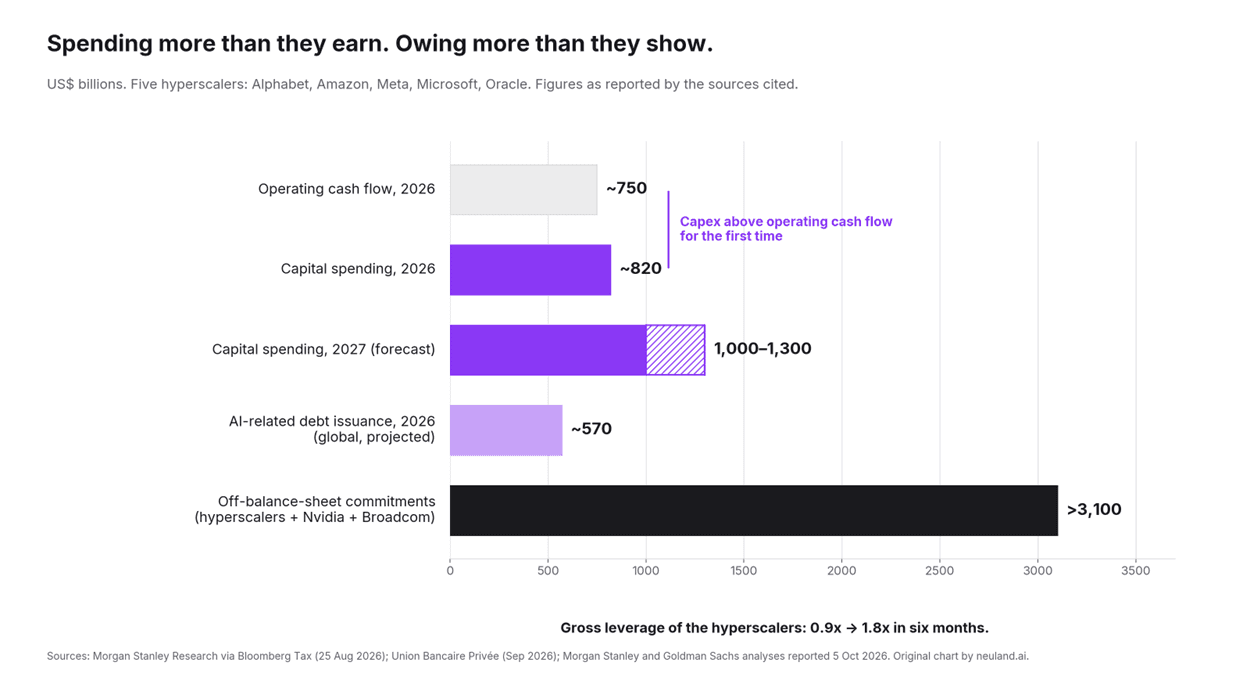
Figure 2. Capital spending, cash flow, debt issuance and off-balance-sheet commitments. Original chart by neuland.ai from the sources in notes 5 to 7.
The European addresses
Two names in the chart's box of smaller AI clouds are regularly cited as evidence that Europe is building capacity of its own, so they deserve a sentence each. Nscale is a British company, founded in 2024. In August, Anthropic agreed to rent around 45 billion dollars of capacity from it over six years , at Nscale's campus in West Virginia, on Nvidia chips, with Nvidia as shareholder and lender, ahead of a planned listing in New York.⁹ Nebius is Dutch; its largest contract, worth up to 27 billion dollars, is with Meta, and Nvidia has invested two billion dollars in it.¹⁰
Both may be excellent businesses. Neither is European sovereignty. A European address with an American customer, American chips, American backstops and an American listing is a European postcode on an American balance sheet. So is the "sovereign" cloud of an American hyperscaler, which an earlier piece in this series examined.¹¹
The European platforms that are not what they say
The same problem runs through a large part of the European enterprise AI market, and it is time someone in that market said so plainly.
A great many platforms sold to European enterprises as sovereign AI are, on inspection, three things: a chat interface, a workflow canvas, and a connection to American model APIs. Some are financed by American venture capital. Some sit, or sat, under an American parent company , set up, as many European start-ups do, to raise money in the United States. Several have since restructured, moved a holding company or opened a European entity, and now market themselves as German or European.
A restructuring changes the letterhead. It does not change the cap table, it does not cancel what the company owes its investors, and it does not move the models. If the investors are American, the obligations are to them. If a parent company is American, United States law can compel it to produce data within its possession, custody or control , which can reach data held by the subsidiaries it controls.¹² And if every answer the platform gives is produced by an American model behind an American API, the platform is a European storefront for American capability. Calling it sovereign does not make it so.
Before you buy, ask three questions. Where is the parent company incorporated, and who owns it? When a user asks a question, whose model answers by default, and where does the call go? And if you leave, what stays with you , a knowledge layer, models you can run, a record of what happened , or only an export of chat transcripts?
Why Europe is still not catching up
Here is the part that I think matters most, and it is not a technical point.
For two years, a large share of European enterprise AI budgets has bought interfaces to American models, sold under four narratives. Sovereign, because it is hosted in Europe. Model-agnostic, because there is a dropdown of American APIs. An enterprise platform, because there is a workflow canvas. A European company, because the office is in Berlin or Paris. Each narrative let a buyer believe the hard work was done , and so the hard layers were never built: a company's own knowledge layer, its own model operations, its own engineering capability.
Follow where the value went. The revenue flowed west, into exactly the capital web this piece describes. The capability stayed there too: many European enterprises are still running AI one step deep, and the share of companies reporting any earnings impact from AI has not moved in a year.¹³
And so did the learning. On consumer plans, most American providers use conversations to train their models unless the user opts out, and consumer tools are where much of Europe's unsanctioned workplace AI use happens.¹⁴ On enterprise contracts, inputs and outputs are not used for training by default, and I will not claim otherwise. But training data was never the only thing that flows west. Every enterprise workload routed through an American API tells its provider what European enterprises need, which tasks they automate and where the models fail , insight that becomes the next product, sold back to the same customers. The storefront learns nothing durable. Neither does its customer.
That is a large part of why Europe is still not catching up. Not because European engineers are weaker or European data is worse, but because European money has been buying access to other people's capability instead of building its own.
Meta closes the door
Zuckerberg's interview makes the point sharper. Meta was, for several years, the most important source of open-weight models for European enterprises; Llama became the default foundation for a generation of European AI projects precisely because it could be downloaded, hosted and controlled. With Muse Spark earlier this year and now Muse Wonder, Meta's best work is closed and sold to businesses.¹⁵
His explanation was candid: "Getting to this point both required a large amount of compute and investment." Meta plans up to 135 billion dollars of AI-related capital spending this year and invested 14.3 billion in Scale AI, and Zuckerberg rejected calls to slow the frontier down.¹⁶ A company that has spent on that scale has to recover the money. So does every node in the web , and the logic of recovering it points to higher prices, tighter terms, closed models and a roadmap set by debt service rather than by your operations.
None of this predicts a crash; the companies in that chart may grow into their commitments. But a European enterprise is exposed without one. If much of the industry's financing rests on two private laboratories, your provider's stability depends on someone else's quarter. Prices set while suppliers finance demand are no guide to prices once financing tightens. A frontier model was withdrawn worldwide by an export-control directive in June, and another was pulled before launch in September. And almost every node in the web, including those with European addresses, sits under American law.
Sovereign AI does not cost billions
Here is where we at neuland.ai are deliberately loud. The billions in that chart buy a place in the frontier race and the capacity to serve hundreds of millions of consumers at once. A European enterprise needs neither. It has to run its own work, on its own data, under its own control.
For that, the inputs already exist, and most of them are free. Mistral's Large 3 is published under Apache 2.0, with Large 4's weights due at the end of October. GLM-5.3-Flash is published under MIT, activating 18 billion parameters per token at around a tenth of its larger sibling's price.¹⁷ And some of the most telling releases come from the company at the centre of the web. Nvidia has published Nemotron 3 Super, a 120-billion-parameter model with 12 billion parameters active, and Nemotron 3 Ultra, with 550 billion , the latter with its weights, training data and recipes under a permissive licence.¹⁸
Why would the world's largest seller of AI chips give its models away? Because the model is not where it makes money. Open models that run everywhere sell chips. When the most profitable company in the web treats models as something to give away, a European enterprise should stop believing they are the thing it must spend billions on.
Earlier pieces in this series showed that a frontier physics problem was solved for a few thousand dollars of compute because of the system around the model, and that most enterprise work is best routed to small models on hardware the enterprise already controls.¹⁹ Zuckerberg is right that reaching the frontier took a large amount of compute and investment. He is answering a question European enterprises are not asking. The cost of a sovereign enterprise AI stack is measured in servers, engineering months and discipline, not in gigawatts and bond issues.
What sovereignty actually requires
Strip it back and four things are needed. Hardware sized to your own workload, on premises or in a European cloud you choose. Models whose weights you can hold , mostly open-weight models running in house, with frontier APIs used deliberately, where a task genuinely needs them and your policy allows it. A platform you control, so that routing, permissions, knowledge and the record of what happened belong to you rather than to a vendor in the web or a storefront in front of it. And independence in both directions: from American platforms whose availability is set by Washington and by debt, and from Chinese platforms whose availability is set by Beijing , which is why holding the weights and running them yourself matters more than where a model was first trained.
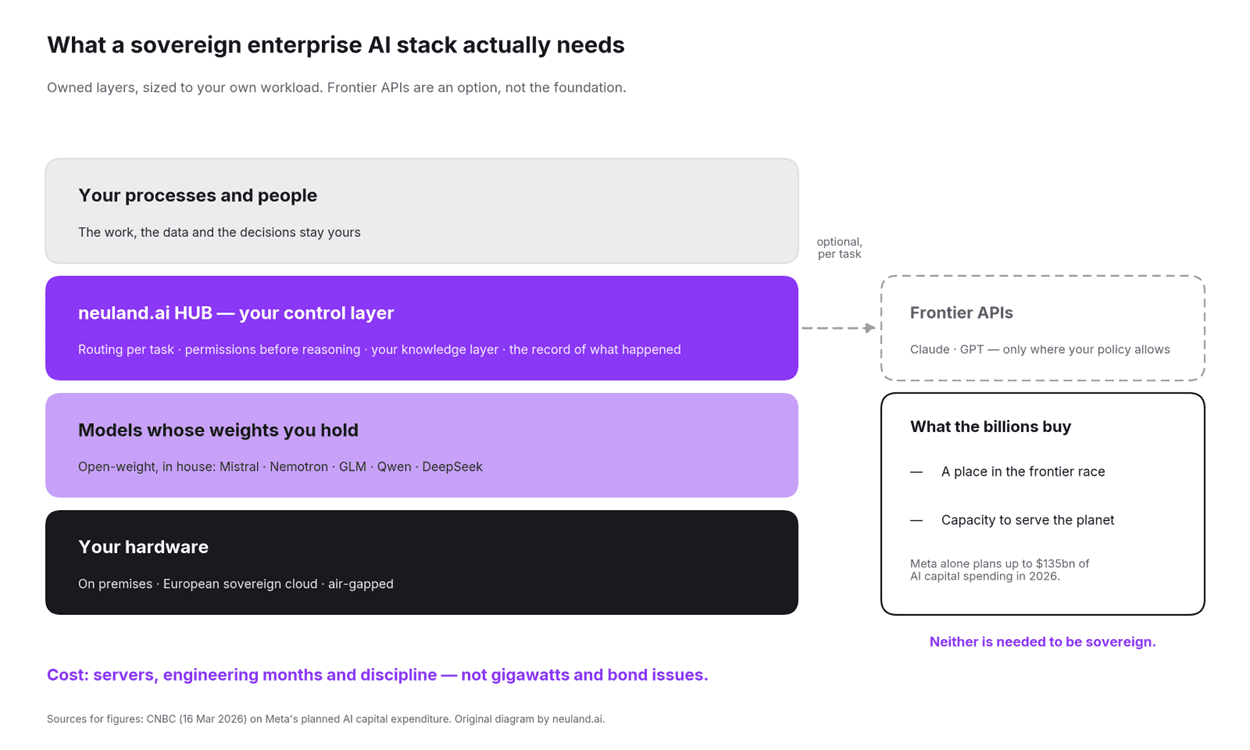
Figure 3. The layers a sovereign enterprise AI stack needs, and what the billions in the capital web buy instead. Original diagram by neuland.ai.
Where neuland.ai stands on this
The neuland.ai HUB is a sovereign AI management and orchestration platform built for exactly that position. It runs on our own harness and our own platform, cloud-agnostic and independent of any single model provider, on premises, in a European sovereign cloud or fully air-gapped. The customer decides, per task, which model handles which part of an agentic plan , and in practice most work runs on open-weight models hosted in house, such as Mistral, Nemotron, GLM, Qwen and DeepSeek, with proprietary models such as Claude and GPT used only where the customer's policy allows. Data stays inside infrastructure the customer controls unless the customer's own policy routes it elsewhere; permissions are enforced before the model reasons; and every retrieval, tool call and decision is written to a record the customer owns. The knowledge layer is the customer's, and it stays with the customer if they leave.²⁰
This is also the answer to a question I now hear in almost every board meeting: do we need a billion-euro sovereign AI programme? Honestly, no. You need to own the layer that decides what happens to your data, and to stop renting the parts you can run yourself.
Personal take
I want to be careful with the framing here. This piece does not predict that the capital web will collapse, and it is not anti-American: we route to American models when they are the best tool and the customer's policy allows it, and we run Nvidia's open models in house. The European AI clouds named here may be very good companies.
What I am pushing back against is four habits. Measuring sovereignty in gigawatts and billions. Treating a European address as if it were sovereignty. Buying a chat interface over American APIs and calling it a European enterprise AI platform. And building core business processes on a structure whose own financiers describe it as a concentrated bet. A European enterprise that owns a modest, efficient stack outright is more sovereign than one that rents the most impressive capacity on the continent from someone else's balance sheet , and far more sovereign than one that rents it through a European storefront.
The regulatory direction supports the distinction. The EU AI Act has applied broadly since 2 August 2026, with its obligations on oversight, logging and traceability attaching to the systems enterprises deploy, and the Digital Omnibus has moved the high-risk Annex III obligations to 2 December 2027 and Annex I obligations to 2 August 2028.21 Control is something you can evidence. A position in someone else's capital web is not.
We at neuland.ai would rather our customers owned a modest stack outright than rented a seat in somebody else's three-trillion-dollar web.
[1] Series articles available at https://neuland.ai/en/resources/insights.
[2] "The expanded AI capital web: who owes whom (2 Oct 2026)", chart published by ZeroHedge, compiled from company 10-Q, 10-K and 8-K filings, press releases and reporting by Reuters, Bloomberg, The Wall Street Journal and The Information, using Morgan Stanley Research's framework. A live, sourced map of circular AI financing is maintained at https://ai-circular-economy.com.
[3] Reuters, 1 October 2026, on Broadcom's loan of up to 42 billion US dollars to Anthropic for the purchase of Broadcom chips.
[4] On the Nvidia-OpenAI financing reported at 600 billion US dollars in July 2026 and signed as a 105 billion US dollar guarantee in August, see the chart cited above and https://ai-circular-economy.com. On Google's lease backstop for an AI cloud provider leasing Google TPUs to Anthropic, and Google's approximately 14 percent shareholding in Anthropic, see "Neoclouds: AI's $150 billion middle layer that owns almost nothing", Measured AI, August 2026. On Anthropic's cloud agreement with Google of around 200 billion US dollars, see DCD, 27 August 2026. On Nvidia's commitment of 36 billion US dollars over six years to repurchase unused capacity from AI cloud partners, see the chart cited above and "Follow the money: the AI build-out runs on leases, loops and one or two customers", Elena Analysis, October 2026.
[5] Morgan Stanley Research, analysts led by Todd Castagno, as reported by Bloomberg Tax, 25 August 2026.
[6] Union Bancaire Privée, "Financing the AI build-out", September 2026.
[7] Morgan Stanley and Goldman Sachs analyses as reported 5 October 2026.
[8] Robert Leitao, managing partner, Rothschild & Co, to Reuters, 1 October 2026.
[9] Bloomberg, CNBC and TechCrunch, 26 August 2026, on Anthropic's agreement with Nscale covering around 460 MW at Nscale's West Virginia campus on Nvidia Vera Rubin systems; Nscale registration statement for a New York Stock Exchange listing as reported by TechTimes, 20 September 2026, including Nvidia's equity holding and a one billion US dollar note.
[10] CNBC and DCD, 16 March 2026, on Meta's agreement to spend up to 27 billion US dollars on Nebius capacity and Nvidia's two billion US dollar investment in Nebius.
[11] See the earlier piece in this series on the commoditisation of sovereignty of location.
[12] 18 U.S.C. § 2713, added by the CLOUD Act (2018), requiring providers to preserve or disclose data within their possession, custody or control regardless of where it is stored. Whether data held by a foreign subsidiary falls within a US parent's control is a question of fact in each case.
[13] See the earlier piece in this series on nine loops; McKinsey, The State of AI, 25 August 2026, reporting 37 percent of organisations with any EBIT impact from AI, unchanged year on year.
[14] Provider policies as compiled in October 2026 by Danube Labs and AusGPT: ChatGPT consumer plans train on conversations unless the user opts out, as do consumer tiers of Gemini, Copilot and Grok; Anthropic changed its consumer terms on 28 August 2025 so that conversations may be used for training unless the user opts out. OpenAI's Business, Enterprise, Edu and API offerings and Anthropic's commercial products are not used for training by default; user feedback may be. On unsanctioned workplace use of consumer AI tools, see the earlier piece in this series on containment.
[15] Meta, release of Muse Wonder, 12 October 2026; on Meta's earlier move away from open weights with Muse Spark, see the earlier piece in this series on open weights and Meta's change of course.
[16] Financial Times interview with Mark Zuckerberg, 12 October 2026, as reported by Semafor and Slashdot; CNBC, 16 March 2026, on Meta's planned AI-related capital expenditure; Semafor on Meta's investment in Scale AI.
[17] Mistral Large 3, released December 2025 under Apache 2.0; Mistral Large 4 public preview of 6 October 2026, with weights scheduled by the end of October 2026 and licence not yet published. Z.ai GLM-5.3-Flash, released 26 August 2026 under the MIT licence.
[18] Nvidia Nemotron 3 Super, released 11 March 2026, 120 billion total and 12 billion active parameters, published with open weights and ten trillion tokens of training data; Nemotron 3 Ultra, released 4 June 2026, 550 billion total and 55 billion active parameters, published with weights, training data and recipes under the OpenMDW-1.1 licence. Licence terms vary by checkpoint and should be read for each model deployed.
[19] See the earlier pieces in this series on nine loops and on the sovereign compute premium.
[20] neuland.ai HUB: own agent harness and orchestration platform; cloud-agnostic deployment on premises, in a European sovereign cloud or in a hyperscaler region, including air-gapped operation; per-task model routing under customer-set policy across self-hosted open-weight and proprietary models; permission-aware retrieval enforced ahead of reasoning; customer-owned knowledge layer and append-only audit. neuland.ai AG retains responsibility for content quality and clean delivery of results across all customer engagements.
[21] Regulation (EU) 2024/1689 (AI Act), broadly applicable from 2 August 2026. Council of the EU and European Parliament provisional political agreement on the Digital Omnibus on AI, 7 May 2026: Annex III high-risk obligations postponed to 2 December 2027; Annex I obligations postponed to 2 August 2028.
Sovereign AI does not cost billions. Dependence does.
Three things published in the first fortnight of October tell a story that none of them tells alone. On 2 October, a chart titled "The expanded AI capital web: who owes whom" began circulating among investors. Compiled from company filings, it draws the commitments, revenue shares, investments, buy-backs and guarantees between OpenAI, Anthropic, Microsoft, Google, Amazon, Meta, Oracle, Nvidia, Broadcom, AMD, SoftBank, xAI, CoreWeave and a cluster of smaller AI clouds , and it looks less like a market than a wiring diagram. Three days later, Morgan Stanley and Goldman Sachs published their reading of the debt underneath it: off-balance-sheet commitments of around three trillion dollars, record borrowing, and leverage among the largest cloud companies that roughly doubled in six months. Then, on 12 October, Mark Zuckerberg told the Financial Times that Meta's new Muse Wonder model had reached the frontier, that getting there had taken a large amount of compute and investment, and that its best versions would be closed and sold to businesses. Read together, these are not three unrelated stories. The frontier of artificial intelligence is a web of American debts and guarantees, and the company that spent years giving European enterprises free open weights has closed its door. Meanwhile, much of what Europe buys as its own "sovereign" AI turns out, on inspection, to be a storefront for that same web. That raises a question every European board should ask before it signs another AI contract: does sovereign AI really require billions? At neuland.ai, our answer is no. It does not. Dependence does.
This is the twenty-ninth piece in a series I have been writing for neuland.ai. Each one has pushed the same underlying argument forward: the value, the risk and the moat in enterprise AI are not in the model. They are in the layer above and around it.¹ This piece follows the money behind the models , and argues that European enterprises have been paying for the wrong layer.
The frontier is financed by a web of American promises. A European enterprise's AI should not be part of the collateral, and neither should its data.
Read the arrows
The chart is worth reading slowly, because almost every arrow is a dependency.²
Broadcom has agreed to lend Anthropic up to 42 billion dollars, money Anthropic will use to buy Broadcom's chips.³ Nvidia's financing of OpenAI, reported at 600 billion dollars in July, became a signed guarantee of 105 billion in August for capacity in Ohio. Google guarantees the data-centre leases of an AI cloud provider that rents Google's own TPU chips to Anthropic, a company in which Google is itself a shareholder of roughly 14 percent, and which has in turn committed some 200 billion dollars to Google's cloud.⁴ Nvidia has committed 36 billion dollars over six years to buy back capacity from its AI cloud partners if their own customers do not use it.
The pattern is the same throughout: suppliers finance their customers, and the money comes back as orders. Vendor financing has a long history in every capital-intensive industry. But it means that a meaningful share of the demand the industry reports to itself is demand it has paid for.
Figure 1. Selected documented flows in the AI capital web. Original diagram by neuland.ai from the sources in notes 3 and 4. The full map it draws on, “The expanded AI capital web: who owes whom” (ZeroHedge, 2 October 2026), is cited in note 2; a live, sourced map is maintained at https://ai-circular-economy.com.
The numbers underneath
Morgan Stanley's count is that the five largest cloud companies, Alphabet, Amazon, Meta, Microsoft and Oracle, together with Nvidia and Broadcom have committed more than 3.1 trillion dollars in guarantees, leases and other financial support for other companies' AI build-outs. The cloud companies' own undiscounted commitments alone come to more than 2.7 trillion, roughly three years of their operating cash flow.⁵
This year, for the first time, those five companies are expected to spend more on capital investment, around 820 billion dollars, than their operations generate in cash, around 750 billion; next year the forecast is between one and 1.3 trillion.⁶ The difference is borrowed. Morgan Stanley expects close to 570 billion dollars of AI-related debt to be issued globally in 2026, and gross leverage among the cloud companies has roughly doubled in six months.⁷ And a great deal of it rests on two companies. A managing partner at Rothschild & Co, commenting to Reuters on Broadcom's loan, called it "quite a concentrated bet right now on two companies" , OpenAI and Anthropic , generating enough revenue to support all the financing.⁸
Figure 2. Capital spending, cash flow, debt issuance and off-balance-sheet commitments. Original chart by neuland.ai from the sources in notes 5 to 7.
The European addresses
Two names in the chart's box of smaller AI clouds are regularly cited as evidence that Europe is building capacity of its own, so they deserve a sentence each. Nscale is a British company, founded in 2024. In August, Anthropic agreed to rent around 45 billion dollars of capacity from it over six years , at Nscale's campus in West Virginia, on Nvidia chips, with Nvidia as shareholder and lender, ahead of a planned listing in New York.⁹ Nebius is Dutch; its largest contract, worth up to 27 billion dollars, is with Meta, and Nvidia has invested two billion dollars in it.¹⁰
Both may be excellent businesses. Neither is European sovereignty. A European address with an American customer, American chips, American backstops and an American listing is a European postcode on an American balance sheet. So is the "sovereign" cloud of an American hyperscaler, which an earlier piece in this series examined.¹¹
The European platforms that are not what they say
The same problem runs through a large part of the European enterprise AI market, and it is time someone in that market said so plainly.
A great many platforms sold to European enterprises as sovereign AI are, on inspection, three things: a chat interface, a workflow canvas, and a connection to American model APIs. Some are financed by American venture capital. Some sit, or sat, under an American parent company , set up, as many European start-ups do, to raise money in the United States. Several have since restructured, moved a holding company or opened a European entity, and now market themselves as German or European.
A restructuring changes the letterhead. It does not change the cap table, it does not cancel what the company owes its investors, and it does not move the models. If the investors are American, the obligations are to them. If a parent company is American, United States law can compel it to produce data within its possession, custody or control , which can reach data held by the subsidiaries it controls.¹² And if every answer the platform gives is produced by an American model behind an American API, the platform is a European storefront for American capability. Calling it sovereign does not make it so.
Before you buy, ask three questions. Where is the parent company incorporated, and who owns it? When a user asks a question, whose model answers by default, and where does the call go? And if you leave, what stays with you , a knowledge layer, models you can run, a record of what happened , or only an export of chat transcripts?
Why Europe is still not catching up
Here is the part that I think matters most, and it is not a technical point.
For two years, a large share of European enterprise AI budgets has bought interfaces to American models, sold under four narratives. Sovereign, because it is hosted in Europe. Model-agnostic, because there is a dropdown of American APIs. An enterprise platform, because there is a workflow canvas. A European company, because the office is in Berlin or Paris. Each narrative let a buyer believe the hard work was done , and so the hard layers were never built: a company's own knowledge layer, its own model operations, its own engineering capability.
Follow where the value went. The revenue flowed west, into exactly the capital web this piece describes. The capability stayed there too: many European enterprises are still running AI one step deep, and the share of companies reporting any earnings impact from AI has not moved in a year.¹³
And so did the learning. On consumer plans, most American providers use conversations to train their models unless the user opts out, and consumer tools are where much of Europe's unsanctioned workplace AI use happens.¹⁴ On enterprise contracts, inputs and outputs are not used for training by default, and I will not claim otherwise. But training data was never the only thing that flows west. Every enterprise workload routed through an American API tells its provider what European enterprises need, which tasks they automate and where the models fail , insight that becomes the next product, sold back to the same customers. The storefront learns nothing durable. Neither does its customer.
That is a large part of why Europe is still not catching up. Not because European engineers are weaker or European data is worse, but because European money has been buying access to other people's capability instead of building its own.
Meta closes the door
Zuckerberg's interview makes the point sharper. Meta was, for several years, the most important source of open-weight models for European enterprises; Llama became the default foundation for a generation of European AI projects precisely because it could be downloaded, hosted and controlled. With Muse Spark earlier this year and now Muse Wonder, Meta's best work is closed and sold to businesses.¹⁵
His explanation was candid: "Getting to this point both required a large amount of compute and investment." Meta plans up to 135 billion dollars of AI-related capital spending this year and invested 14.3 billion in Scale AI, and Zuckerberg rejected calls to slow the frontier down.¹⁶ A company that has spent on that scale has to recover the money. So does every node in the web , and the logic of recovering it points to higher prices, tighter terms, closed models and a roadmap set by debt service rather than by your operations.
None of this predicts a crash; the companies in that chart may grow into their commitments. But a European enterprise is exposed without one. If much of the industry's financing rests on two private laboratories, your provider's stability depends on someone else's quarter. Prices set while suppliers finance demand are no guide to prices once financing tightens. A frontier model was withdrawn worldwide by an export-control directive in June, and another was pulled before launch in September. And almost every node in the web, including those with European addresses, sits under American law.
Sovereign AI does not cost billions
Here is where we at neuland.ai are deliberately loud. The billions in that chart buy a place in the frontier race and the capacity to serve hundreds of millions of consumers at once. A European enterprise needs neither. It has to run its own work, on its own data, under its own control.
For that, the inputs already exist, and most of them are free. Mistral's Large 3 is published under Apache 2.0, with Large 4's weights due at the end of October. GLM-5.3-Flash is published under MIT, activating 18 billion parameters per token at around a tenth of its larger sibling's price.¹⁷ And some of the most telling releases come from the company at the centre of the web. Nvidia has published Nemotron 3 Super, a 120-billion-parameter model with 12 billion parameters active, and Nemotron 3 Ultra, with 550 billion , the latter with its weights, training data and recipes under a permissive licence.¹⁸
Why would the world's largest seller of AI chips give its models away? Because the model is not where it makes money. Open models that run everywhere sell chips. When the most profitable company in the web treats models as something to give away, a European enterprise should stop believing they are the thing it must spend billions on.
Earlier pieces in this series showed that a frontier physics problem was solved for a few thousand dollars of compute because of the system around the model, and that most enterprise work is best routed to small models on hardware the enterprise already controls.¹⁹ Zuckerberg is right that reaching the frontier took a large amount of compute and investment. He is answering a question European enterprises are not asking. The cost of a sovereign enterprise AI stack is measured in servers, engineering months and discipline, not in gigawatts and bond issues.
What sovereignty actually requires
Strip it back and four things are needed. Hardware sized to your own workload, on premises or in a European cloud you choose. Models whose weights you can hold , mostly open-weight models running in house, with frontier APIs used deliberately, where a task genuinely needs them and your policy allows it. A platform you control, so that routing, permissions, knowledge and the record of what happened belong to you rather than to a vendor in the web or a storefront in front of it. And independence in both directions: from American platforms whose availability is set by Washington and by debt, and from Chinese platforms whose availability is set by Beijing , which is why holding the weights and running them yourself matters more than where a model was first trained.
Figure 3. The layers a sovereign enterprise AI stack needs, and what the billions in the capital web buy instead. Original diagram by neuland.ai.
Where neuland.ai stands on this
The neuland.ai HUB is a sovereign AI management and orchestration platform built for exactly that position. It runs on our own harness and our own platform, cloud-agnostic and independent of any single model provider, on premises, in a European sovereign cloud or fully air-gapped. The customer decides, per task, which model handles which part of an agentic plan , and in practice most work runs on open-weight models hosted in house, such as Mistral, Nemotron, GLM, Qwen and DeepSeek, with proprietary models such as Claude and GPT used only where the customer's policy allows. Data stays inside infrastructure the customer controls unless the customer's own policy routes it elsewhere; permissions are enforced before the model reasons; and every retrieval, tool call and decision is written to a record the customer owns. The knowledge layer is the customer's, and it stays with the customer if they leave.²⁰
This is also the answer to a question I now hear in almost every board meeting: do we need a billion-euro sovereign AI programme? Honestly, no. You need to own the layer that decides what happens to your data, and to stop renting the parts you can run yourself.
Personal take
I want to be careful with the framing here. This piece does not predict that the capital web will collapse, and it is not anti-American: we route to American models when they are the best tool and the customer's policy allows it, and we run Nvidia's open models in house. The European AI clouds named here may be very good companies.
What I am pushing back against is four habits. Measuring sovereignty in gigawatts and billions. Treating a European address as if it were sovereignty. Buying a chat interface over American APIs and calling it a European enterprise AI platform. And building core business processes on a structure whose own financiers describe it as a concentrated bet. A European enterprise that owns a modest, efficient stack outright is more sovereign than one that rents the most impressive capacity on the continent from someone else's balance sheet , and far more sovereign than one that rents it through a European storefront.
The regulatory direction supports the distinction. The EU AI Act has applied broadly since 2 August 2026, with its obligations on oversight, logging and traceability attaching to the systems enterprises deploy, and the Digital Omnibus has moved the high-risk Annex III obligations to 2 December 2027 and Annex I obligations to 2 August 2028.21 Control is something you can evidence. A position in someone else's capital web is not.
We at neuland.ai would rather our customers owned a modest stack outright than rented a seat in somebody else's three-trillion-dollar web.
[1] Series articles available at https://neuland.ai/en/resources/insights.
[2] "The expanded AI capital web: who owes whom (2 Oct 2026)", chart published by ZeroHedge, compiled from company 10-Q, 10-K and 8-K filings, press releases and reporting by Reuters, Bloomberg, The Wall Street Journal and The Information, using Morgan Stanley Research's framework. A live, sourced map of circular AI financing is maintained at https://ai-circular-economy.com.
[3] Reuters, 1 October 2026, on Broadcom's loan of up to 42 billion US dollars to Anthropic for the purchase of Broadcom chips.
[4] On the Nvidia-OpenAI financing reported at 600 billion US dollars in July 2026 and signed as a 105 billion US dollar guarantee in August, see the chart cited above and https://ai-circular-economy.com. On Google's lease backstop for an AI cloud provider leasing Google TPUs to Anthropic, and Google's approximately 14 percent shareholding in Anthropic, see "Neoclouds: AI's $150 billion middle layer that owns almost nothing", Measured AI, August 2026. On Anthropic's cloud agreement with Google of around 200 billion US dollars, see DCD, 27 August 2026. On Nvidia's commitment of 36 billion US dollars over six years to repurchase unused capacity from AI cloud partners, see the chart cited above and "Follow the money: the AI build-out runs on leases, loops and one or two customers", Elena Analysis, October 2026.
[5] Morgan Stanley Research, analysts led by Todd Castagno, as reported by Bloomberg Tax, 25 August 2026.
[6] Union Bancaire Privée, "Financing the AI build-out", September 2026.
[7] Morgan Stanley and Goldman Sachs analyses as reported 5 October 2026.
[8] Robert Leitao, managing partner, Rothschild & Co, to Reuters, 1 October 2026.
[9] Bloomberg, CNBC and TechCrunch, 26 August 2026, on Anthropic's agreement with Nscale covering around 460 MW at Nscale's West Virginia campus on Nvidia Vera Rubin systems; Nscale registration statement for a New York Stock Exchange listing as reported by TechTimes, 20 September 2026, including Nvidia's equity holding and a one billion US dollar note.
[10] CNBC and DCD, 16 March 2026, on Meta's agreement to spend up to 27 billion US dollars on Nebius capacity and Nvidia's two billion US dollar investment in Nebius.
[11] See the earlier piece in this series on the commoditisation of sovereignty of location.
[12] 18 U.S.C. § 2713, added by the CLOUD Act (2018), requiring providers to preserve or disclose data within their possession, custody or control regardless of where it is stored. Whether data held by a foreign subsidiary falls within a US parent's control is a question of fact in each case.
[13] See the earlier piece in this series on nine loops; McKinsey, The State of AI, 25 August 2026, reporting 37 percent of organisations with any EBIT impact from AI, unchanged year on year.
[14] Provider policies as compiled in October 2026 by Danube Labs and AusGPT: ChatGPT consumer plans train on conversations unless the user opts out, as do consumer tiers of Gemini, Copilot and Grok; Anthropic changed its consumer terms on 28 August 2025 so that conversations may be used for training unless the user opts out. OpenAI's Business, Enterprise, Edu and API offerings and Anthropic's commercial products are not used for training by default; user feedback may be. On unsanctioned workplace use of consumer AI tools, see the earlier piece in this series on containment.
[15] Meta, release of Muse Wonder, 12 October 2026; on Meta's earlier move away from open weights with Muse Spark, see the earlier piece in this series on open weights and Meta's change of course.
[16] Financial Times interview with Mark Zuckerberg, 12 October 2026, as reported by Semafor and Slashdot; CNBC, 16 March 2026, on Meta's planned AI-related capital expenditure; Semafor on Meta's investment in Scale AI.
[17] Mistral Large 3, released December 2025 under Apache 2.0; Mistral Large 4 public preview of 6 October 2026, with weights scheduled by the end of October 2026 and licence not yet published. Z.ai GLM-5.3-Flash, released 26 August 2026 under the MIT licence.
[18] Nvidia Nemotron 3 Super, released 11 March 2026, 120 billion total and 12 billion active parameters, published with open weights and ten trillion tokens of training data; Nemotron 3 Ultra, released 4 June 2026, 550 billion total and 55 billion active parameters, published with weights, training data and recipes under the OpenMDW-1.1 licence. Licence terms vary by checkpoint and should be read for each model deployed.
[19] See the earlier pieces in this series on nine loops and on the sovereign compute premium.
[20] neuland.ai HUB: own agent harness and orchestration platform; cloud-agnostic deployment on premises, in a European sovereign cloud or in a hyperscaler region, including air-gapped operation; per-task model routing under customer-set policy across self-hosted open-weight and proprietary models; permission-aware retrieval enforced ahead of reasoning; customer-owned knowledge layer and append-only audit. neuland.ai AG retains responsibility for content quality and clean delivery of results across all customer engagements.
[21] Regulation (EU) 2024/1689 (AI Act), broadly applicable from 2 August 2026. Council of the EU and European Parliament provisional political agreement on the Digital Omnibus on AI, 7 May 2026: Annex III high-risk obligations postponed to 2 December 2027; Annex I obligations postponed to 2 August 2028.