Research
The theorems are falling. Enterprise EBIT is flat. The gap is not the technology.
The theorems are falling. Enterprise EBIT is flat. The gap is not the technology.

Dr. Anoj Winston Gladius
·
18
Min. Lesezeit

AI as a bridge between enterprise and engineering tools.
aufsatz
Image: AI generated with neuland.ai HUB
On 8 September 2026 OpenAI announced that an unreleased internal model had produced a solution to the Navier-Stokes existence and smoothness problem — one of the seven Millennium Prize Problems set by the Clay Mathematics Institute in 2000. The system ran as a multi-agent architecture which at one point had ten thousand sub-agents working different parts and variations of the problem, took eighty-eight hours, and produced a proof written in Lean, the formal verification language, so that the argument could be checked by a kernel rather than believed on assertion. Two weeks earlier, on 25 August, McKinsey published its State of AI survey: 1,719 respondents across 97 countries, fielded through May and early June. Eighty percent of organisations report individual productivity gains from AI. Thirty-seven percent report any impact on earnings. That second number is flat against the previous year. The share of respondents attributing five percent or more of EBIT to AI sits at roughly six percent, and it has not moved either. So in the same fortnight, artificial intelligence closed a problem that had been open since 1934 and failed, for the second consecutive year, to move the earnings of the organisations paying for it. The comfortable reading is that research is ahead of practice and enterprise will catch up. I think that reading is wrong, and I think it is expensive. The science is not working because the models are better than the ones enterprises have. It is working because the systems built around those models have properties that almost nothing sold into the enterprise market has. And the reason enterprises cannot tell the difference is that the market has stopped rewarding depth — to the point where a well-received agent-platform announcement this season was automatic archiving of the agents nobody uses, a sensible tidying feature that leaves the reason they are unused entirely untouched.
This is the twenty-third piece in a series I have been writing for neuland.ai. [¹] It is more direct than the previous twenty-two, because I have spent a year arguing this structurally and the numbers have now made the structural argument urgent.
What actually happened in the mathematics
The Navier-Stokes announcement arrived inside a priority dispute, and the dispute is worth understanding rather than skipping, because the honest version of the story is more instructive than the press release.
Tristan Buckmaster of NYU's Courant Institute and Levent Alpöge of Harvard had been working on the problem for around a year, building on an approach developed by Córdoba and Martínez-Zoroa. On 15 August they proved that the Euler equations — the frictionless simplification of Navier-Stokes — do in fact blow up, using models from Anthropic and OpenAI, and verified the result in Lean. On 7 September they published that result and stated they had obtained a solution to the more general problem. OpenAI, by its own account, turned its resources onto Navier-Stokes on 1 September, after hearing rumours of their work, and announced on 8 September. Buckmaster has publicly accused OpenAI of attempting to appropriate the discovery. [²]
I have no standing to adjudicate that and I am not going to try. What matters here is what both accounts agree on, and it is a description of an architecture rather than of a model.
There was deep domain grounding. A year of expert work, inside a specific mathematical framework, by people who understood which lines of attack were plausible. The models did not decide what to try.
There was model-agnostic orchestration. Models from at least two competing vendors were used, chosen per sub-problem. Nobody involved cared whose logo was on the inference.
There was a deterministic verification gate. The proof is trusted because Lean's kernel checked it. Not because a model asserted it, not because a reviewer found it convincing, and not because it read fluently — which matters, because by Buckmaster's account the natural-language explanation the models produced was barely readable and the mathematicians had to reconstruct the steps by hand so that other researchers could follow them.
There was massive parallel decomposition with durable state. Thousands of sub-agents on a task graph, running for days, with results accumulating rather than evaporating.
And there was expert judgement at the boundary. Humans decided what the output meant and made it legible.
Five properties. Now hold that list against what a typical enterprise AI deployment consists of: a chat interface, a vector store, a system prompt, and a subscription.
Why the McKinsey numbers are right and the interpretation is wrong
The survey is not measuring a technology that does not work. It is measuring the deployment of something that was never built to work.
Look at what the same report found. Thirty-two percent of organisations declined at least one software purchase because agentic coding tools let them build it themselves. Large enterprises scaling agents in one or more functions rose from twenty-seven to forty percent in a year, while smaller organisations stayed flat at twenty-two. Twenty percent report that AI operating costs, including token costs, have already constrained their use of AI. [³]
Read those together and the picture is not of a technology failing to deliver. It is of a market in which capability is real, concentrated in organisations that have platform and governance capacity, expensive to run, and mostly deployed as productivity tooling rather than as engineering capability. Eighty percent feel faster. Thirty-seven percent can find it in the accounts. That gap is exactly what you would predict if a large share of enterprise AI spending had gone on interfaces rather than on systems.
Independent numbers point the same way. Gartner has around seventeen percent of organisations having actually deployed agents. Deloitte puts production-ready agentic systems at about eleven percent. [⁴] Nobody is failing to deploy because the models are inadequate. GLM, Kimi, Claude, GPT and their open-weight siblings are all, at this point, capable of far more than most enterprises are asking of them.
What is actually being sold
I want to be precise about the failure rather than gesture at it, so here is the shape of the thing.
A large part of the enterprise AI market consists of products that wrap a frontier model in a chat window, add retrieval over a document store, and describe the result as an AI platform. These products demonstrate beautifully. They handle the twenty questions a buyer asks in a workshop. They fail on the ones that arrive in month four — the query that needs three hops across two source systems, the answer that has to cite a clause and survive an audit, the workflow that must produce the same result twice, the retrieval that must respect an access control list held in a different system from the index.
And because the market cannot easily tell the difference at purchase time, vendors are not punished for the gap. They are rewarded for tidying.
A well-received announcement in the agent-platform space recently added automatic archiving: agents nobody has used for a while drop out of the workspace list, so the ones people rely on are easier to find. It is a sensible feature and it does not touch the problem. Finding the right agent becomes harder than building a new one only if agents are standalone artefacts in a flat list — if the platform knew what each one operated on, which systems and which entities in the customer's own domain model, discovery would be a query rather than a scroll, and it would not degrade as the count grew. Archiving hides a graveyard the architecture will keep filling. [⁵] And the market's enthusiasm is the tell rather than the product: if tidying the list is a headline capability, buyers cannot yet distinguish depth from packaging. That is why the earnings number is flat while the science is closing century-old problems.
What serious industrial AI actually looks like
Here is the part I care about most, because it is where the gap is widest and where the research community has already done the work.
The model does not do the engineering. This is the point that almost every enterprise AI product gets wrong, and the Navier-Stokes case demonstrates it perfectly: the model did not verify the proof. Lean verified the proof. The model planned, explored, decomposed and proposed; a deterministic system established what was true.
Apply that pattern to industrial engineering and the architecture becomes obvious. There is thirty years of world-class open-source scientific and engineering software — computational geometry kernels, finite element and computational fluid dynamics solvers, mesh generators, constraint solvers, optimisers, format libraries for every industrial interchange standard. Built by the research community, validated over decades, freely available, and almost entirely unused inside enterprises because driving it requires expertise that does not scale.
That is the actual opportunity. Not a model that pretends to know aerodynamics, but an orchestration layer that can set up the case, drive the established solver, read the result, decide what to change, and iterate — with every step recorded and every claim checkable. The intelligence is in the planning and the interpretation. The truth comes from the tools.
Two examples from our own work.
The first is process engineering documentation, which is my own background. A piping and instrumentation diagram is the canonical description of a process plant: equipment, lines, instruments, control loops, valves, set points, tie-ins, all of it carrying tag numbers that must agree across drawings, equipment lists, cause-and-effect matrices and revision histories. Analysing a set of them is a graph problem wearing the costume of a drawing, and doing it properly means extracting the structure from documents that are frequently scans, reconciling tags across revisions and across document types, tracing loops end to end, and identifying what is missing, orphaned or inconsistent.
The mechanism that makes this tractable is not a better model. It is multimodal ingestion that handles the drawings as drawings; an ontology that knows what an item of equipment, a line, an instrument and a control loop are and how they relate, so that a tag in one document and the same tag in another are recognised as the same entity; deterministic checks that run over the extracted graph so that a consistency finding is a computed fact rather than a model's impression; agentic threads for the multi-hop reconciliation that no single query can express; and an audit trail so that an engineer can see why every finding was raised and reject it on the evidence. The model reads and cross-references. The deterministic layer decides what counts as a defect. An engineer decides what matters.
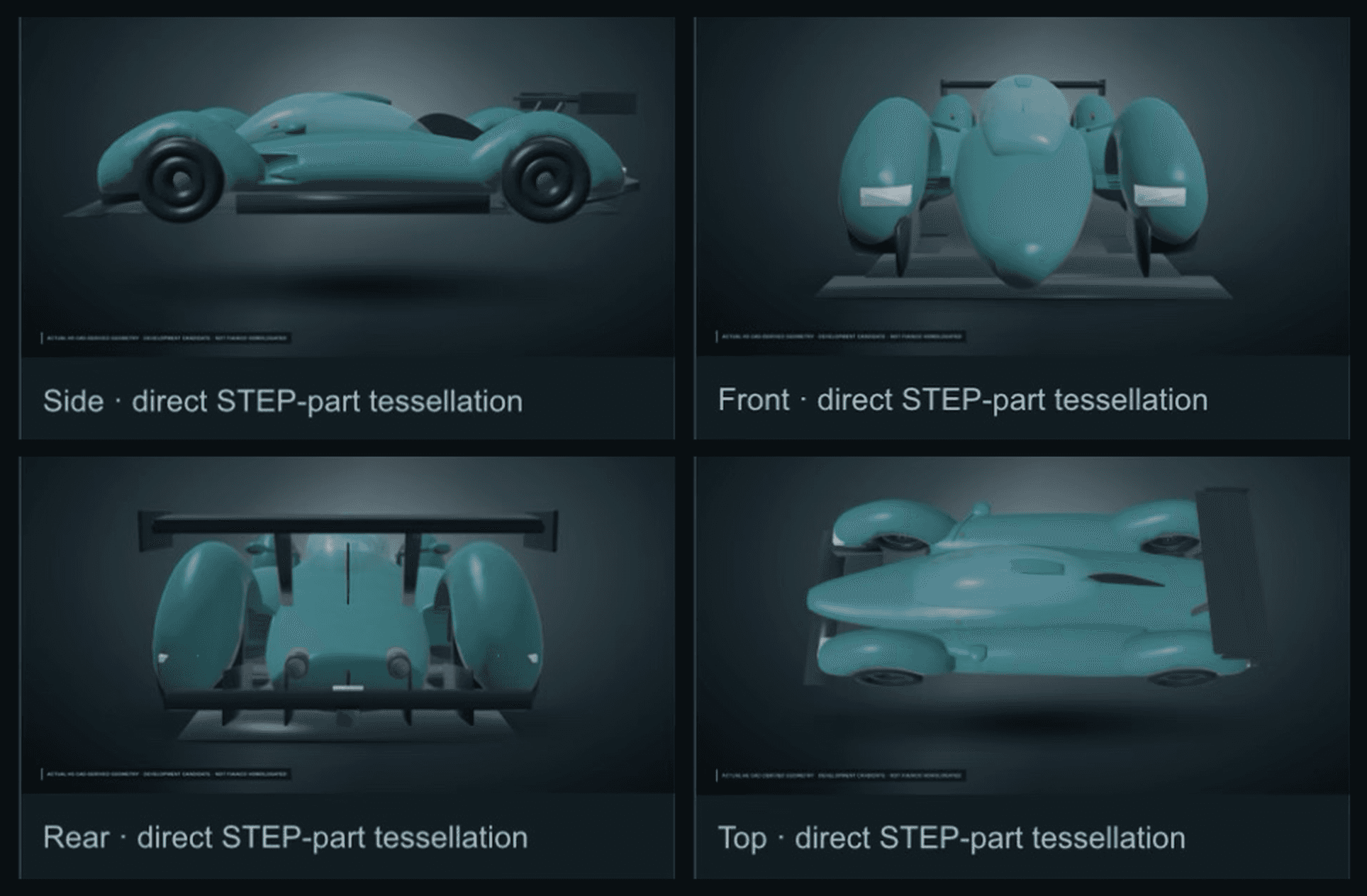
Four views, tessellated directly from the STEP parts. Renders are cheap; the point is what sits behind them.
The second is geometry, and I can show it. Our research team has been running an internal exercise on Le Mans Hypercar bodywork — chosen deliberately because the regulations are public, the geometric constraints are unforgiving, and the work is either right or it is not.
Four views, tessellated directly from the STEP parts. Renders are cheap; the point is what sits behind them.
What matters is not that a pleasant-looking car appeared. Anything can generate a pleasant-looking car. What matters is that the output is an exact-geometry master with an evidence package attached.
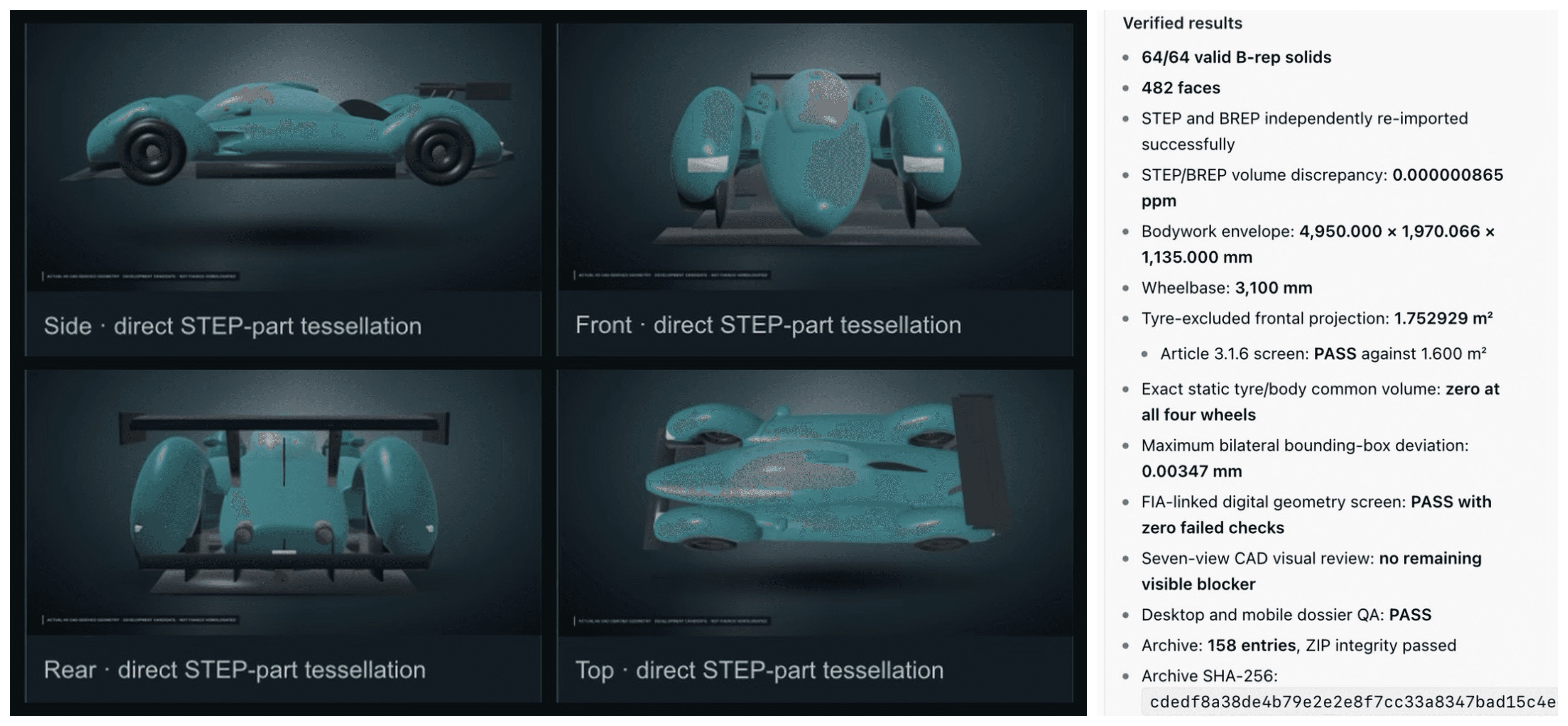
The geometry beside its verification record. Every figure on the right is computed by open-source computational geometry, not asserted by a language model.
Sixty-four of sixty-four valid B-rep solids.
STEP and native BREP masters that both re-import independently, with a volume discrepancy between the two representations of under one part per billion.
Bodywork envelope and wheelbase to the millimetre.
Tyre-excluded frontal projection computed at 1.752929 m² and screened against the regulation's 1.600 m² threshold.
Exact static tyre-body common volume of zero at all four wheels.
Maximum bilateral bounding-box deviation of 0.00347 mm.
A regulation-linked geometry screen passing with zero failed checks.
An archive of 158 entries with a SHA-256 hash over the whole thing.
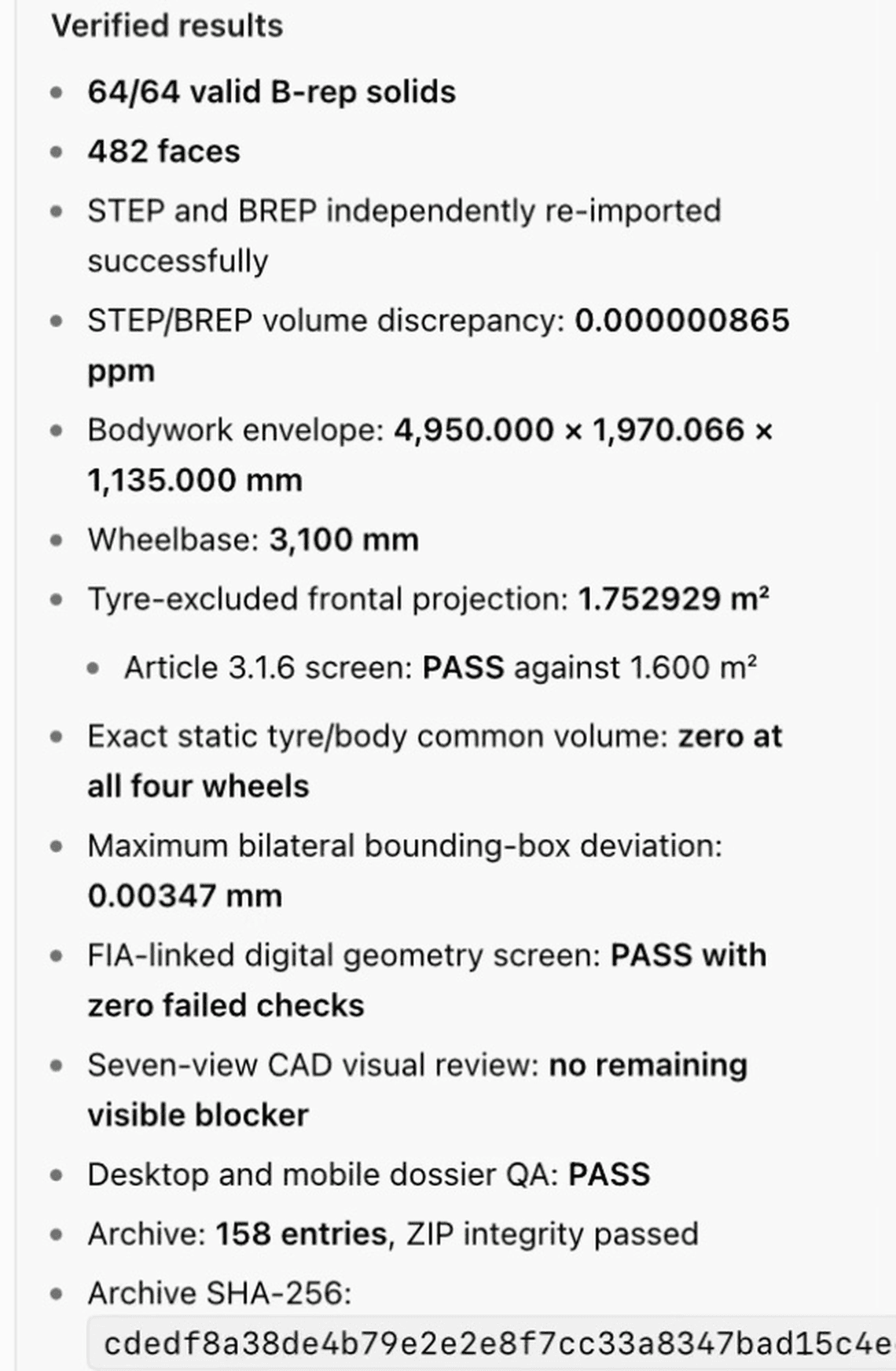
Verification record for the exact-geometry master.
Every one of those is a computed number produced by open-source computational geometry, not an assertion by a language model. The model drove the process; the kernel established the facts. That is the same division of labour as the Lean proof, applied to an industrial artefact — and it is what makes the result something an engineer can argue with rather than something a buyer has to trust.
And the honest boundary, stated as plainly as it is stated internally: this is a pre-certification master. It is measurable, re-importable and independently auditable. It is not FIA or ACO homologated, not design-released, and not manufacturing-ready. Anyone who tells you a language model produced a homologated racing car is selling you something. What has been produced is a rigorous, checkable starting point that removes an enormous amount of the geometry work that normally precedes the certifiable design round — and which the next round then has to earn.
This is internal research rather than a shipped product line, though customers have begun running their own work through it. I would rather say that than imply otherwise.
Where neuland.ai stands
The reason we can do this is not that we have a better model. We have no model. It is that the platform was built around the five properties that the mathematics case demonstrates, because those properties are what regulated industrial work needs and they cannot be added afterwards. [⁶]
Routing across models per workload, chosen on capability, cost, residency and policy rather than on whose inference we sell — because we sell none. An ontology that carries the customer's own domain: what an entity is in their plant, their fleet, their portfolio, and how those entities relate. Orchestration that is deterministic where a result must be reproducible and agentic where the path cannot be enumerated in advance, with the choice made per task. Execution that can drive real engineering tooling inside a sandbox rather than describing what such tooling would output. Verification as a first-class step, so a claim is checked by something other than the model that made it. And an append-only record of every retrieval, decision and tool call, so that a finding can be traced to its evidence months later.
That list is not a feature comparison. It is the answer to why a language model can help close a Millennium Prize problem and cannot, on its own, tell you whether your P&ID set is internally consistent.
Personal take
I have been measured in this series for twenty-two pieces, so let me be blunt for one.
Enterprise AI is not underperforming because the technology is immature. In the same month that the earnings numbers came in flat for the second consecutive year, a multi-agent system closed a problem that had defeated mathematicians since 1934, and open-weight models reached the frontier at a fortieth of last year's cost. The technology is extraordinary and it is cheap.
Enterprise AI is underperforming because a large share of the money went to products that could never have worked, bought by people who had no way to tell, from vendors who were not required to explain how anything functioned. The result is an industry-wide association between the words enterprise AI and disappointing pilot, which is now actively holding back the organisations that would benefit most — the industrial companies, the engineering firms, the regulated institutions with forty years of accumulated process knowledge and a genuine need for systems that can reason over it.
Those organisations have been told, by their own experience, that this technology does not deliver. What they were actually told is that a chat interface over a document store does not deliver, which was always true and which the research community could have told them for free.
The gap between the mathematics and the earnings statement is not a gap in capability. It is a gap in architecture, and it will close for the organisations that start asking vendors how things work rather than what they can do in a demonstration. The tools the research community has built over three decades are sitting there, free, validated, and waiting for someone to drive them properly.
We would rather be judged on a geometry package with a hash on it than on a demonstration.
A brief note on the regulatory backdrop, since it continues to develop. The EU AI Act became broadly applicable on 2 August 2026, with GPAI enforcement powers under Chapter V binding from that date; the Digital Omnibus agreement of 7 May 2026 postponed the high-risk Annex III obligations to 2 December 2027 and Annex I obligations to 2 August 2028. [⁷] Relevant here: an architecture in which claims are established by deterministic tooling and recorded against evidence is dramatically easier to document under that regime than one in which the answer is whatever the model said. The compliance case and the engineering case are the same case.
The theorems are falling. The gap is not the technology. That is the work in front of us, and it is the work we have been doing.
Series articles at neuland.ai/en/resources/insights.
OpenAI announcement of 8 September 2026 concerning the Navier-Stokes existence and smoothness problem, one of the seven Millennium Prize Problems designated by the Clay Mathematics Institute in 2000. Reported architecture: a multi-agent system coordinated by an unreleased internal model, at one point running approximately ten thousand sub-agents in parallel, over roughly eighty-eight hours, with a simplified version of the question answered earlier in approximately fifty hours using around one thousand agents; proof published with a formalisation in Lean. Priority dispute: Tristan Buckmaster (Courant Institute, NYU) and Levent Alpöge (Harvard) had worked on the problem for approximately one year, building on an approach of Córdoba and Martínez-Zoroa, proving blow-up for the Euler equations on 15 August 2026 using models from Anthropic and OpenAI and verifying the result in Lean, and published their inviscid-case result on 7 September 2026 while stating that a solution to the more general problem would follow. OpenAI has said it focused resources on the problem on 1 September 2026 after hearing rumours of that work. Buckmaster has publicly alleged an attempt to appropriate the discovery. Buckmaster's account also notes that the natural-language explanation produced by the models was barely readable and that the steps had to be reconstructed manually for other researchers. Coverage: Nature, Fortune, Scientific American, 8–9 September 2026. This piece takes no position on the priority question.
McKinsey, State of AI, published 25 August 2026; 1,719 respondents across 97 countries, fielded 4 May to 8 June 2026, weighted by each country's share of global GDP. Findings referenced: 80 percent reporting individual productivity gains against 37 percent reporting any EBIT impact, the latter flat year on year; approximately 6 percent attributing 5 percent or more of EBIT to AI, also flat; 32 percent declining at least one software purchase because agentic coding tools enabled internal build, with sector variation from approximately 41 percent in technology to 19 percent in insurance and 17 percent in the public sector; large enterprises scaling agents in one or more functions rising from 27 to 40 percent while smaller organisations remained flat at 22 percent; 20 percent reporting that AI operating costs including token costs constrained their use of AI.
Gartner CIO survey data indicating approximately 17 percent of organisations having deployed AI agents; Deloitte Tech Trends 2026 placing production-ready agentic systems at approximately 11 percent.
See earlier pieces in this series arguing that the meaningful unit is the stated outcome rather than the hand-constructed flow, and that a platform should provide the governed substrate an agent runs on rather than attempting to be the agent.
For the architectural properties referenced and the argument that they are decided at design time rather than added later, see the earlier piece in this series setting out the definition of an enterprise AI orchestration and management platform.
Council of the EU and European Parliament provisional political agreement on the Digital Omnibus on AI, 7 May 2026: Annex III high-risk obligations postponed to 2 December 2027; Annex I obligations postponed to 2 August 2028; Article 50(2) watermarking obligations moved to 2 December 2026. GPAI enforcement powers under Chapter V binding from 2 August 2026.
On 8 September 2026 OpenAI announced that an unreleased internal model had produced a solution to the Navier-Stokes existence and smoothness problem — one of the seven Millennium Prize Problems set by the Clay Mathematics Institute in 2000. The system ran as a multi-agent architecture which at one point had ten thousand sub-agents working different parts and variations of the problem, took eighty-eight hours, and produced a proof written in Lean, the formal verification language, so that the argument could be checked by a kernel rather than believed on assertion. Two weeks earlier, on 25 August, McKinsey published its State of AI survey: 1,719 respondents across 97 countries, fielded through May and early June. Eighty percent of organisations report individual productivity gains from AI. Thirty-seven percent report any impact on earnings. That second number is flat against the previous year. The share of respondents attributing five percent or more of EBIT to AI sits at roughly six percent, and it has not moved either. So in the same fortnight, artificial intelligence closed a problem that had been open since 1934 and failed, for the second consecutive year, to move the earnings of the organisations paying for it. The comfortable reading is that research is ahead of practice and enterprise will catch up. I think that reading is wrong, and I think it is expensive. The science is not working because the models are better than the ones enterprises have. It is working because the systems built around those models have properties that almost nothing sold into the enterprise market has. And the reason enterprises cannot tell the difference is that the market has stopped rewarding depth — to the point where a well-received agent-platform announcement this season was automatic archiving of the agents nobody uses, a sensible tidying feature that leaves the reason they are unused entirely untouched.
This is the twenty-third piece in a series I have been writing for neuland.ai. [¹] It is more direct than the previous twenty-two, because I have spent a year arguing this structurally and the numbers have now made the structural argument urgent.
What actually happened in the mathematics
The Navier-Stokes announcement arrived inside a priority dispute, and the dispute is worth understanding rather than skipping, because the honest version of the story is more instructive than the press release.
Tristan Buckmaster of NYU's Courant Institute and Levent Alpöge of Harvard had been working on the problem for around a year, building on an approach developed by Córdoba and Martínez-Zoroa. On 15 August they proved that the Euler equations — the frictionless simplification of Navier-Stokes — do in fact blow up, using models from Anthropic and OpenAI, and verified the result in Lean. On 7 September they published that result and stated they had obtained a solution to the more general problem. OpenAI, by its own account, turned its resources onto Navier-Stokes on 1 September, after hearing rumours of their work, and announced on 8 September. Buckmaster has publicly accused OpenAI of attempting to appropriate the discovery. [²]
I have no standing to adjudicate that and I am not going to try. What matters here is what both accounts agree on, and it is a description of an architecture rather than of a model.
There was deep domain grounding. A year of expert work, inside a specific mathematical framework, by people who understood which lines of attack were plausible. The models did not decide what to try.
There was model-agnostic orchestration. Models from at least two competing vendors were used, chosen per sub-problem. Nobody involved cared whose logo was on the inference.
There was a deterministic verification gate. The proof is trusted because Lean's kernel checked it. Not because a model asserted it, not because a reviewer found it convincing, and not because it read fluently — which matters, because by Buckmaster's account the natural-language explanation the models produced was barely readable and the mathematicians had to reconstruct the steps by hand so that other researchers could follow them.
There was massive parallel decomposition with durable state. Thousands of sub-agents on a task graph, running for days, with results accumulating rather than evaporating.
And there was expert judgement at the boundary. Humans decided what the output meant and made it legible.
Five properties. Now hold that list against what a typical enterprise AI deployment consists of: a chat interface, a vector store, a system prompt, and a subscription.
Why the McKinsey numbers are right and the interpretation is wrong
The survey is not measuring a technology that does not work. It is measuring the deployment of something that was never built to work.
Look at what the same report found. Thirty-two percent of organisations declined at least one software purchase because agentic coding tools let them build it themselves. Large enterprises scaling agents in one or more functions rose from twenty-seven to forty percent in a year, while smaller organisations stayed flat at twenty-two. Twenty percent report that AI operating costs, including token costs, have already constrained their use of AI. [³]
Read those together and the picture is not of a technology failing to deliver. It is of a market in which capability is real, concentrated in organisations that have platform and governance capacity, expensive to run, and mostly deployed as productivity tooling rather than as engineering capability. Eighty percent feel faster. Thirty-seven percent can find it in the accounts. That gap is exactly what you would predict if a large share of enterprise AI spending had gone on interfaces rather than on systems.
Independent numbers point the same way. Gartner has around seventeen percent of organisations having actually deployed agents. Deloitte puts production-ready agentic systems at about eleven percent. [⁴] Nobody is failing to deploy because the models are inadequate. GLM, Kimi, Claude, GPT and their open-weight siblings are all, at this point, capable of far more than most enterprises are asking of them.
What is actually being sold
I want to be precise about the failure rather than gesture at it, so here is the shape of the thing.
A large part of the enterprise AI market consists of products that wrap a frontier model in a chat window, add retrieval over a document store, and describe the result as an AI platform. These products demonstrate beautifully. They handle the twenty questions a buyer asks in a workshop. They fail on the ones that arrive in month four — the query that needs three hops across two source systems, the answer that has to cite a clause and survive an audit, the workflow that must produce the same result twice, the retrieval that must respect an access control list held in a different system from the index.
And because the market cannot easily tell the difference at purchase time, vendors are not punished for the gap. They are rewarded for tidying.
A well-received announcement in the agent-platform space recently added automatic archiving: agents nobody has used for a while drop out of the workspace list, so the ones people rely on are easier to find. It is a sensible feature and it does not touch the problem. Finding the right agent becomes harder than building a new one only if agents are standalone artefacts in a flat list — if the platform knew what each one operated on, which systems and which entities in the customer's own domain model, discovery would be a query rather than a scroll, and it would not degrade as the count grew. Archiving hides a graveyard the architecture will keep filling. [⁵] And the market's enthusiasm is the tell rather than the product: if tidying the list is a headline capability, buyers cannot yet distinguish depth from packaging. That is why the earnings number is flat while the science is closing century-old problems.
What serious industrial AI actually looks like
Here is the part I care about most, because it is where the gap is widest and where the research community has already done the work.
The model does not do the engineering. This is the point that almost every enterprise AI product gets wrong, and the Navier-Stokes case demonstrates it perfectly: the model did not verify the proof. Lean verified the proof. The model planned, explored, decomposed and proposed; a deterministic system established what was true.
Apply that pattern to industrial engineering and the architecture becomes obvious. There is thirty years of world-class open-source scientific and engineering software — computational geometry kernels, finite element and computational fluid dynamics solvers, mesh generators, constraint solvers, optimisers, format libraries for every industrial interchange standard. Built by the research community, validated over decades, freely available, and almost entirely unused inside enterprises because driving it requires expertise that does not scale.
That is the actual opportunity. Not a model that pretends to know aerodynamics, but an orchestration layer that can set up the case, drive the established solver, read the result, decide what to change, and iterate — with every step recorded and every claim checkable. The intelligence is in the planning and the interpretation. The truth comes from the tools.
Two examples from our own work.
The first is process engineering documentation, which is my own background. A piping and instrumentation diagram is the canonical description of a process plant: equipment, lines, instruments, control loops, valves, set points, tie-ins, all of it carrying tag numbers that must agree across drawings, equipment lists, cause-and-effect matrices and revision histories. Analysing a set of them is a graph problem wearing the costume of a drawing, and doing it properly means extracting the structure from documents that are frequently scans, reconciling tags across revisions and across document types, tracing loops end to end, and identifying what is missing, orphaned or inconsistent.
The mechanism that makes this tractable is not a better model. It is multimodal ingestion that handles the drawings as drawings; an ontology that knows what an item of equipment, a line, an instrument and a control loop are and how they relate, so that a tag in one document and the same tag in another are recognised as the same entity; deterministic checks that run over the extracted graph so that a consistency finding is a computed fact rather than a model's impression; agentic threads for the multi-hop reconciliation that no single query can express; and an audit trail so that an engineer can see why every finding was raised and reject it on the evidence. The model reads and cross-references. The deterministic layer decides what counts as a defect. An engineer decides what matters.
Four views, tessellated directly from the STEP parts. Renders are cheap; the point is what sits behind them.
The second is geometry, and I can show it. Our research team has been running an internal exercise on Le Mans Hypercar bodywork — chosen deliberately because the regulations are public, the geometric constraints are unforgiving, and the work is either right or it is not.
Four views, tessellated directly from the STEP parts. Renders are cheap; the point is what sits behind them.
What matters is not that a pleasant-looking car appeared. Anything can generate a pleasant-looking car. What matters is that the output is an exact-geometry master with an evidence package attached.
The geometry beside its verification record. Every figure on the right is computed by open-source computational geometry, not asserted by a language model.
Sixty-four of sixty-four valid B-rep solids.
STEP and native BREP masters that both re-import independently, with a volume discrepancy between the two representations of under one part per billion.
Bodywork envelope and wheelbase to the millimetre.
Tyre-excluded frontal projection computed at 1.752929 m² and screened against the regulation's 1.600 m² threshold.
Exact static tyre-body common volume of zero at all four wheels.
Maximum bilateral bounding-box deviation of 0.00347 mm.
A regulation-linked geometry screen passing with zero failed checks.
An archive of 158 entries with a SHA-256 hash over the whole thing.
Verification record for the exact-geometry master.
Every one of those is a computed number produced by open-source computational geometry, not an assertion by a language model. The model drove the process; the kernel established the facts. That is the same division of labour as the Lean proof, applied to an industrial artefact — and it is what makes the result something an engineer can argue with rather than something a buyer has to trust.
And the honest boundary, stated as plainly as it is stated internally: this is a pre-certification master. It is measurable, re-importable and independently auditable. It is not FIA or ACO homologated, not design-released, and not manufacturing-ready. Anyone who tells you a language model produced a homologated racing car is selling you something. What has been produced is a rigorous, checkable starting point that removes an enormous amount of the geometry work that normally precedes the certifiable design round — and which the next round then has to earn.
This is internal research rather than a shipped product line, though customers have begun running their own work through it. I would rather say that than imply otherwise.
Where neuland.ai stands
The reason we can do this is not that we have a better model. We have no model. It is that the platform was built around the five properties that the mathematics case demonstrates, because those properties are what regulated industrial work needs and they cannot be added afterwards. [⁶]
Routing across models per workload, chosen on capability, cost, residency and policy rather than on whose inference we sell — because we sell none. An ontology that carries the customer's own domain: what an entity is in their plant, their fleet, their portfolio, and how those entities relate. Orchestration that is deterministic where a result must be reproducible and agentic where the path cannot be enumerated in advance, with the choice made per task. Execution that can drive real engineering tooling inside a sandbox rather than describing what such tooling would output. Verification as a first-class step, so a claim is checked by something other than the model that made it. And an append-only record of every retrieval, decision and tool call, so that a finding can be traced to its evidence months later.
That list is not a feature comparison. It is the answer to why a language model can help close a Millennium Prize problem and cannot, on its own, tell you whether your P&ID set is internally consistent.
Personal take
I have been measured in this series for twenty-two pieces, so let me be blunt for one.
Enterprise AI is not underperforming because the technology is immature. In the same month that the earnings numbers came in flat for the second consecutive year, a multi-agent system closed a problem that had defeated mathematicians since 1934, and open-weight models reached the frontier at a fortieth of last year's cost. The technology is extraordinary and it is cheap.
Enterprise AI is underperforming because a large share of the money went to products that could never have worked, bought by people who had no way to tell, from vendors who were not required to explain how anything functioned. The result is an industry-wide association between the words enterprise AI and disappointing pilot, which is now actively holding back the organisations that would benefit most — the industrial companies, the engineering firms, the regulated institutions with forty years of accumulated process knowledge and a genuine need for systems that can reason over it.
Those organisations have been told, by their own experience, that this technology does not deliver. What they were actually told is that a chat interface over a document store does not deliver, which was always true and which the research community could have told them for free.
The gap between the mathematics and the earnings statement is not a gap in capability. It is a gap in architecture, and it will close for the organisations that start asking vendors how things work rather than what they can do in a demonstration. The tools the research community has built over three decades are sitting there, free, validated, and waiting for someone to drive them properly.
We would rather be judged on a geometry package with a hash on it than on a demonstration.
A brief note on the regulatory backdrop, since it continues to develop. The EU AI Act became broadly applicable on 2 August 2026, with GPAI enforcement powers under Chapter V binding from that date; the Digital Omnibus agreement of 7 May 2026 postponed the high-risk Annex III obligations to 2 December 2027 and Annex I obligations to 2 August 2028. [⁷] Relevant here: an architecture in which claims are established by deterministic tooling and recorded against evidence is dramatically easier to document under that regime than one in which the answer is whatever the model said. The compliance case and the engineering case are the same case.
The theorems are falling. The gap is not the technology. That is the work in front of us, and it is the work we have been doing.
Series articles at neuland.ai/en/resources/insights.
OpenAI announcement of 8 September 2026 concerning the Navier-Stokes existence and smoothness problem, one of the seven Millennium Prize Problems designated by the Clay Mathematics Institute in 2000. Reported architecture: a multi-agent system coordinated by an unreleased internal model, at one point running approximately ten thousand sub-agents in parallel, over roughly eighty-eight hours, with a simplified version of the question answered earlier in approximately fifty hours using around one thousand agents; proof published with a formalisation in Lean. Priority dispute: Tristan Buckmaster (Courant Institute, NYU) and Levent Alpöge (Harvard) had worked on the problem for approximately one year, building on an approach of Córdoba and Martínez-Zoroa, proving blow-up for the Euler equations on 15 August 2026 using models from Anthropic and OpenAI and verifying the result in Lean, and published their inviscid-case result on 7 September 2026 while stating that a solution to the more general problem would follow. OpenAI has said it focused resources on the problem on 1 September 2026 after hearing rumours of that work. Buckmaster has publicly alleged an attempt to appropriate the discovery. Buckmaster's account also notes that the natural-language explanation produced by the models was barely readable and that the steps had to be reconstructed manually for other researchers. Coverage: Nature, Fortune, Scientific American, 8–9 September 2026. This piece takes no position on the priority question.
McKinsey, State of AI, published 25 August 2026; 1,719 respondents across 97 countries, fielded 4 May to 8 June 2026, weighted by each country's share of global GDP. Findings referenced: 80 percent reporting individual productivity gains against 37 percent reporting any EBIT impact, the latter flat year on year; approximately 6 percent attributing 5 percent or more of EBIT to AI, also flat; 32 percent declining at least one software purchase because agentic coding tools enabled internal build, with sector variation from approximately 41 percent in technology to 19 percent in insurance and 17 percent in the public sector; large enterprises scaling agents in one or more functions rising from 27 to 40 percent while smaller organisations remained flat at 22 percent; 20 percent reporting that AI operating costs including token costs constrained their use of AI.
Gartner CIO survey data indicating approximately 17 percent of organisations having deployed AI agents; Deloitte Tech Trends 2026 placing production-ready agentic systems at approximately 11 percent.
See earlier pieces in this series arguing that the meaningful unit is the stated outcome rather than the hand-constructed flow, and that a platform should provide the governed substrate an agent runs on rather than attempting to be the agent.
For the architectural properties referenced and the argument that they are decided at design time rather than added later, see the earlier piece in this series setting out the definition of an enterprise AI orchestration and management platform.
Council of the EU and European Parliament provisional political agreement on the Digital Omnibus on AI, 7 May 2026: Annex III high-risk obligations postponed to 2 December 2027; Annex I obligations postponed to 2 August 2028; Article 50(2) watermarking obligations moved to 2 December 2026. GPAI enforcement powers under Chapter V binding from 2 August 2026.